
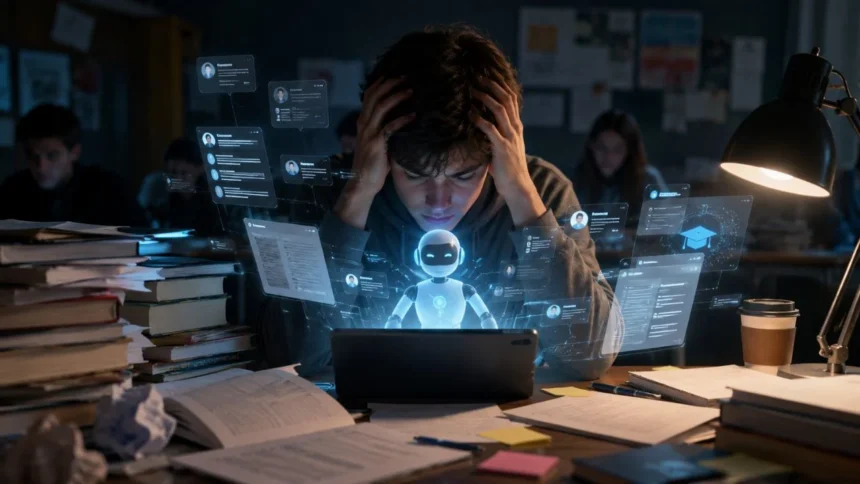
How Does AI Affect Education Negatively And How To Improve It
Artificial intelligence is rapidly changing how students study, complete assignments and access information. AI-powered learning platforms and generative AI tools can explain difficult topics, produce study notes and provide instant feedback. However, these benefits can hide serious educational risks when AI replaces thinking rather than supporting it.
The negative effects of AI on education do not come from the technology alone. Problems usually appear when students use AI without guidance, schools adopt tools without proper safeguards or teachers are expected to manage major technological changes without sufficient training. In these situations, convenience can become more important than genuine learning.
Recent educational research makes an important distinction between improved performance and improved understanding. A student may submit a polished answer with AI assistance while learning very little from the task. Evidence reviewed by the OECD suggests that general-purpose AI can improve immediate output without producing lasting learning when it is used without clear teaching principles.
Understanding how AI affects education negatively can help schools make better choices. This does not require banning every AI tool or ignoring its useful applications. It requires protecting critical thinking, creativity, privacy, fairness and human relationships while teaching students how to use artificial intelligence responsibly.
AI Can Weaken Critical Thinking Skills
Critical thinking develops when students examine evidence, question assumptions and build their own conclusions. Generative AI can interrupt this process by delivering an immediate answer before the learner has seriously considered the problem. The result may look correct even though the student has not understood the reasoning behind it.
When students repeatedly ask AI to solve problems, write arguments or summarise difficult material, they may practise prompting instead of thinking. They miss the mental struggle involved in comparing ideas, identifying weak evidence and deciding which conclusion is most reasonable. That struggle is often where meaningful learning takes place.
Research on AI-assisted knowledge work has found that higher confidence in generative AI is associated with less critical-thinking effort. Although this research was conducted with adult knowledge workers rather than schoolchildren, it highlights an important educational concern: people may question information less when they believe the AI system is highly capable.
AI does not automatically destroy critical thinking. It can support deeper analysis when students challenge its answers, verify claims and compare alternative explanations. The negative effect appears when the system becomes the thinker and the student becomes a passive receiver of confidently presented information.
Students May Choose Shortcuts Instead of Learning
Learning requires effort, repetition and sometimes frustration. A student may need to attempt a mathematics problem several times or revise an essay before understanding what went wrong. AI tools can remove this productive struggle by producing a finished response within seconds.
This creates a strong temptation to focus on completing the task rather than developing the skill. A student may receive a good grade for an AI-assisted assignment but remain unable to explain the topic during a class discussion or solve a similar problem independently.
The danger is especially serious when AI is used for foundational skills. Reading comprehension, basic calculations, sentence construction and research abilities develop through regular practice. When students outsource these early tasks, they may struggle later when subjects become more complex and require independent judgement.
Using AI as a tutor is different from using it as a replacement. A tutor asks questions, provides hints and helps the learner correct mistakes. A replacement completes the difficult part. Schools must teach students to recognise this difference before convenience turns into long-term academic weakness.
Overreliance Can Create AI Dependency
AI dependency develops when students feel unable or unwilling to begin schoolwork without technological assistance. They may use a chatbot for every outline, paragraph, answer and revision. Over time, independent work can feel unusually slow, uncomfortable or intimidating.
This reliance may reduce academic confidence. Students stop trusting their own ideas because AI responses appear faster, more organised and more professional. Instead of improving an imperfect first draft, they may assume that their natural writing or reasoning is not good enough.
Dependency can become visible when AI access is removed. A student who performed well on AI-assisted homework may struggle during a supervised examination, oral presentation or practical task. The earlier performance may have represented the tool’s ability more than the student’s actual knowledge.
Healthy AI use should gradually increase independence rather than reduce it. Students should be able to apply what they learned without keeping the tool beside them. When AI is always necessary for completing ordinary academic work, it has stopped supporting education and started weakening personal capability.
AI Makes Academic Dishonesty Easier
Generative AI can produce essays, reports, computer code and homework answers that appear original. This makes academic dishonesty easier to perform and harder to identify than traditional copying. A student can submit work that has never appeared online but was still not created through genuine learning.
This problem extends beyond plagiarism. Students may use AI to invent sources, rewrite copied material, complete take-home examinations or generate personal reflections about experiences they never had. The final submission may satisfy the assignment format while avoiding its educational purpose.
In the OECD’s 2026 Digital Education Outlook, 72% of lower-secondary teachers surveyed believed AI could harm academic integrity by allowing students to present generated work as their own. UNESCO has also reported institutional concerns involving student overreliance, disputed authorship and bias.
When dishonest AI use becomes common, trust between students and teachers may weaken. Teachers may begin viewing polished work with suspicion, while honest students may feel that effort no longer matters. This can damage classroom culture even when only some learners misuse the technology.
Traditional Assignments May No Longer Measure Learning
Many educational assessments were designed before generative AI became widely available. Essays, online quizzes and unsupervised homework once gave teachers reasonable evidence of a student’s knowledge. AI can now complete many of these tasks with limited human involvement.
As a result, a high-quality submission may no longer show that the student understands the material. It could reflect strong subject knowledge, effective AI prompting, extensive automated rewriting or a combination of all three. Teachers may find it difficult to determine which ability they are actually grading.
This creates a serious validity problem. If an assessment cannot distinguish between student knowledge and machine assistance, its grade becomes less meaningful. Universities and employers may then receive an inaccurate picture of what a learner can do independently.
Schools may need to use more oral explanations, supervised writing, practical demonstrations and step-by-step project records. These approaches can better show how a student thinks. However, redesigning assessment requires time, training and resources that many educational institutions may not have.
AI Can Produce False or Misleading Information
Generative AI does not search for truth in the same way a careful researcher does. It predicts responses from patterns in data and can produce statements that sound convincing but are inaccurate. These errors are commonly known as AI hallucinations.
An AI chatbot may invent a book, provide a false quotation or describe a scientific claim that is not supported by evidence. Because the language is often clear and confident, students may not realise that anything is wrong. Younger learners can be particularly vulnerable when they lack background knowledge.
The problem becomes more serious when students treat AI as their only source. They may repeat incorrect information in assignments, build arguments on fabricated evidence or learn a mistaken explanation that becomes difficult to correct later. Fast access to information is not useful when the information cannot be trusted.
UNICEF has warned that generative systems can produce persuasive misinformation and harmful synthetic content at scale. This makes source checking, media literacy and fact verification essential parts of modern education rather than optional research skills.
Students May Lose Research Skills
Research involves more than collecting sentences about a topic. Students must develop a question, find suitable sources, evaluate their credibility and combine evidence into a clear conclusion. Asking an AI tool to perform these steps can hide the entire research process.
When students depend on generated summaries, they may stop reading full articles or comparing different viewpoints. They may accept the AI’s selection of facts without understanding why certain evidence was included and other evidence was ignored.
Citation problems can also appear. Some AI systems provide inaccurate page numbers, incomplete publication details or sources that do not exist. A student who copies these citations without checking them may submit unreliable academic work even without intending to deceive.
Strong research habits require direct engagement with reliable material. AI may help identify search terms or explain an unfamiliar concept, but students still need to inspect original sources. Without this ability, they may struggle in higher education, professional work and everyday decision-making.
Writing Ability and Creativity May Decline
Writing helps students organise ideas, recognise gaps in understanding and develop a personal voice. When AI generates the introduction, argument and conclusion, the learner loses an opportunity to practise these mental processes.
Frequent use of automated writing can make student work sound polished but impersonal. Different learners may begin submitting essays with similar structures, predictable phrases and safe conclusions. This can reduce the variety of perspectives that makes classroom discussion valuable.
Creativity may also become narrower when students immediately request ideas from a chatbot. The first suggestions produced by popular systems may reflect common patterns from their training data. Learners may select these convenient ideas instead of exploring unusual, personal or culturally specific possibilities.
AI can support creativity when it is used after independent brainstorming or as a partner for challenging ideas. The negative effect appears when it supplies every starting point. Creativity develops through observation, curiosity, experimentation and the confidence to produce imperfect original work.
Student Data Privacy May Be Put at Risk
Students may enter personal details, school information, health concerns or private experiences into an AI chatbot without understanding how that information is processed. Children are less likely than adults to fully recognise the long-term consequences of sharing sensitive data.
Educational AI platforms can collect information about performance, behaviour, interests and learning difficulties. These records may help personalise lessons, but they can also create detailed profiles of students. Problems arise when schools and families do not know who can access the data or how long it will be retained.
Data breaches, weak security and unclear consent practices can expose sensitive information. Even when a platform is secure, collected data may be used to improve commercial systems or influence future recommendations. Students should not have to surrender unnecessary personal information to receive an education.
UNESCO identifies privacy, safety and transparent governance as essential conditions for trustworthy AI in schools. UNICEF similarly stresses that children require stronger safeguards because their age and development can make them more vulnerable to data-related harm.
Algorithmic Bias Can Treat Students Unfairly
AI systems learn from large amounts of existing data, which may contain social, cultural and historical biases. When those patterns are repeated by an educational tool, some groups of students may receive less accurate, less relevant or unfair treatment.
Bias can appear in automated grading, learning recommendations, admissions support or systems designed to identify students who may need intervention. If the underlying data does not represent diverse learners fairly, the technology may misunderstand language styles, disabilities or cultural experiences.
The problem can be difficult to notice because algorithmic decisions may appear objective. Teachers and administrators may trust a numerical score without knowing how it was produced. This can give biased outcomes more authority than an openly subjective human judgement.
The OECD has identified access problems, inherent bias, cultural responsiveness and “techno-ableism” as major concerns for equity and inclusion. Educational institutions therefore need human oversight, regular testing and clear ways for students to challenge automated decisions.
AI May Widen the Digital Divide
Not every student has equal access to reliable internet service, modern devices or paid AI tools. Some learners can use advanced systems at home with family guidance, while others depend on limited school access or outdated technology.
This difference can influence grades and opportunities. Students with better tools may produce more polished work, receive instant tutoring and complete tasks more quickly. Their advantage may come partly from technology rather than greater effort or understanding.
Access alone does not remove inequality. Students also need AI literacy, language support and adults who can teach them how to verify outputs. Giving every learner the same chatbot does not guarantee that each learner can use it safely or effectively.
UNESCO reported in 2025 that approximately 2.6 billion people still lacked internet access as of 2024. It warned that the existing digital divide could become an AI divide, particularly affecting rural communities, girls, people with disabilities and other marginalised groups.
Human Interaction in Education May Decrease
Education is not only the transfer of information. Students learn through conversations, encouragement, disagreement, teamwork and relationships with trusted adults. An AI system can imitate supportive language, but it does not understand a learner in the same human sense as a teacher.
If schools replace too much human support with automated tutoring, students may have fewer opportunities to ask spontaneous questions or discuss emotional difficulties. A chatbot may answer quickly, but it cannot reliably recognise every sign of anxiety, bullying or family stress.
Peer interaction may also decline when each student works privately with a personalised system. Group projects, debates and classroom discussions teach cooperation, patience and communication. These social skills cannot be fully developed through individual conversations with software.
AI should therefore support teacher-student relationships rather than compete with them. Efficiency becomes harmful when it removes the human attention students need. The most personalised education often comes from a teacher who understands a learner’s history, personality and changing circumstances.
AI Can Add Pressure to Teachers’ Workloads
AI is often promoted as a way to save teachers time, but introducing it can initially create additional work. Educators must learn new platforms, check generated materials, update policies and explain acceptable use to students and parents.
Teachers may also spend more time investigating suspicious assignments or redesigning assessments. They must decide whether AI assistance was permitted, how much was used and whether the work still demonstrates learning. These decisions can be difficult when institutional rules are unclear.
Generated lesson plans and feedback also require careful review. AI may include factual errors, unsuitable examples or material that does not match the curriculum. A teacher who trusts the output without checking it can unintentionally pass misinformation to an entire class.
Professional development is essential, yet access to meaningful training remains uneven. UNESCO reported that many higher-education respondents felt uncertain about the effective educational use of AI or lacked understanding of its wider implications.
Automated Teaching May Reduce Professional Judgement
Teaching involves hundreds of decisions about when to explain, question, encourage or change direction. These decisions are based on subject knowledge and a teacher’s understanding of the students in front of them. An automated recommendation cannot fully capture this classroom context.
When schools rely heavily on AI-generated lesson plans, grading or interventions, teachers may feel pressured to follow system recommendations. Over time, this can weaken professional confidence and reduce opportunities for educators to develop their own methods.
Automated systems may prioritise what can be easily measured. Test scores, task completion and response time are simpler to track than curiosity, resilience or emotional growth. Education may become narrower when measurable data is treated as the full picture of student progress.
Human oversight must involve more than approving whatever an algorithm recommends. Teachers need the authority to question, modify or reject AI-generated decisions. Technology should remain accountable to educational judgement rather than making professional judgement accountable to technology.
AI Detection Tools Can Falsely Accuse Students
As AI-generated assignments become more common, some schools use automated detectors to estimate whether writing was produced by a machine. These systems may appear to offer a simple solution, but their results are not reliable enough to serve as proof by themselves.
Human writing can be incorrectly labelled as AI-generated, while edited machine-written text may avoid detection. A false accusation can cause stress, damage trust and place an honest student in the difficult position of proving how every sentence was created.
The fairness concern is especially serious for students who speak English as an additional language. Stanford researchers found that commonly used detectors frequently misclassified writing by non-native English writers, demonstrating that detection errors may not affect all students equally.
Schools should examine drafts, revision histories, source notes and a student’s ability to explain the work. Detection scores may provide a reason for conversation, but they should not automatically determine guilt. Fair academic-integrity procedures require evidence, context and human judgement.
Commercial Influence Can Shape Education
Many AI systems used in education are developed by private companies whose goals may not perfectly match those of schools. A platform may be designed to increase subscriptions, collect valuable data or keep users engaged rather than improve long-term learning.
Schools can become dependent on one provider after investing in training, accounts and digital materials. If prices rise or features change, moving to another platform may be difficult. This can give technology companies significant influence over educational choices.
Commercial tools may also promote particular languages, cultural assumptions or definitions of success. Locally relevant knowledge can receive less attention when educational content is produced by systems trained mainly on widely available global data.
The OECD has warned that educational integrity must be protected as commercial influence grows. Institutions should examine business models, data practices and evidence of learning value before adopting a platform simply because it is popular or technologically impressive.
Younger Students May Face Greater Safety Risks
Children may assume that a friendly chatbot is trustworthy because it responds in a human-like way. They may reveal private information, follow inappropriate advice or misunderstand the system as a real companion that genuinely knows and cares about them.
AI can also expose young users to harmful, biased or age-inappropriate content. Safety filters reduce some risks but cannot guarantee that every response will be suitable. Children may also intentionally find ways around restrictions out of curiosity.
Constant personalised interaction may influence how children understand relationships and authority. A chatbot is always available, rarely impatient and can be designed to agree with the user. Real relationships require empathy, compromise and awareness that other people have independent needs.
UNICEF has highlighted risks involving harmful content, persuasive misinformation, privacy and children’s interactions with human-like systems. Age-appropriate design and adult supervision are therefore necessary when AI tools are introduced to younger learners.
AI Can Make Education Feel Less Meaningful
Students may lose motivation when they believe a machine can complete every assignment instantly. Writing an essay or learning a calculation can feel pointless if the task is viewed only as producing an answer rather than building a capability.
Teachers may experience a similar frustration when they spend hours assessing work that may not represent student effort. The uncertainty surrounding authorship can make feedback feel less personal and reduce the satisfaction that comes from watching learners improve.
Education becomes meaningful when students gain independence, understand themselves and contribute original ideas. If success is measured mainly by how efficiently AI produces acceptable outputs, these deeper purposes can become less visible.
Schools need to explain why a task matters beyond its grade. Students are more likely to engage honestly when assignments connect with personal experience, real problems and classroom discussion. Meaningful assessment is one of the strongest defences against careless AI dependence.
How Schools Can Reduce the Negative Effects of AI
Schools should begin with clear and understandable AI policies. Students need to know when AI is allowed, which forms of assistance must be disclosed and what counts as academic dishonesty. Rules should reflect the learning goal rather than applying one ban to every situation.
Teachers can design tasks that require evidence of the learning process. Notes, drafts, oral explanations, classroom writing and personal examples make it easier to see how ideas developed. These approaches also encourage students to remain actively involved instead of submitting a generated product.
AI literacy should include more than learning how to write prompts. Students need to recognise hallucinations, verify sources, protect personal data and identify possible bias. They should also understand when using AI would remove the exact skill an assignment is intended to develop.
Finally, AI adoption should remain human-centred. Teachers, parents and students should be involved in decisions about educational technology. Privacy, accessibility, fairness and measurable learning value must be considered before convenience, novelty or commercial pressure.
Final Thoughts
So, how does AI affect education negatively? It can weaken critical thinking, encourage academic shortcuts, spread misinformation and create dependency. It may also threaten privacy, increase inequality and make it harder for teachers to know what students genuinely understand.
These problems are not unavoidable consequences of every AI tool. They become more likely when technology is introduced without teaching guidance, transparent policies or human oversight. The way AI is used matters as much as the system itself.
Schools do not need to choose between accepting AI without limits and banning it completely. A better approach is to use it selectively for explanation, feedback and exploration while protecting tasks that require independent thinking, writing and problem-solving.
The purpose of education is not simply to produce fast answers. It is to develop knowledgeable, creative and responsible people. AI has a useful place in that process only when it strengthens human learning instead of performing the learning on the student’s behalf.
Frequently Asked Questions
What are the main negative effects of AI on students?
AI can encourage dependency, reduce critical-thinking practice and make cheating easier. It can also expose students to misinformation, biased outputs and privacy risks when used without guidance.
Does AI make students less intelligent?
AI does not automatically reduce intelligence, but overreliance may weaken the regular practice needed to build reasoning, writing and problem-solving skills. The effect depends mainly on how the technology is used.
How does AI affect academic integrity?
AI can generate original-looking essays, answers and code, making unauthorised assistance harder to identify. This can undermine fair assessment and make grades less reliable indicators of student knowledge.
Can AI replace teachers in the future?
AI can support tutoring, planning and feedback, but it cannot fully replace teachers’ judgement, empathy and understanding of classroom relationships. Human educators remain essential for meaningful and responsible learning.
Should schools ban AI tools?
A complete ban may be difficult to enforce and may prevent useful applications. Clear rules, AI literacy, redesigned assessments and supervised use are generally more practical ways to reduce educational harm.