
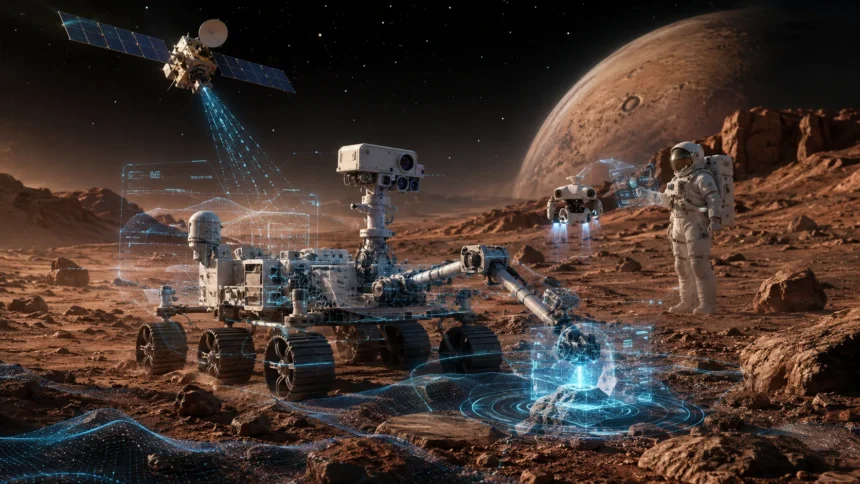
How Is AI Used in Space Exploration? Real Uses Transforming Space Missions
Artificial intelligence is becoming an increasingly valuable part of modern space exploration. Spacecraft travel enormous distances, collect huge amounts of scientific data, and frequently operate where communication with Earth is delayed or limited. AI helps overcome these challenges by allowing machines to analyze information, recognize patterns, navigate difficult terrain, and make certain decisions without waiting for constant instructions from human controllers.
Today, AI in space exploration is used in Mars rovers, Earth-observing satellites, astronomical research, spacecraft monitoring, autonomous navigation, and mission planning. Machine learning and computer vision can process information far faster than humans manually reviewing every photograph, sensor reading, or scientific measurement. This makes space missions more productive while allowing scientists to focus their attention on the observations most likely to produce valuable discoveries.
The technology is advancing quickly. In 2026, NASA reported that the Perseverance Mars rover completed the first drives on another world using routes planned by a vision-capable generative AI system. Elsewhere, intelligent satellite systems are learning to select useful observations, avoid clouds, recognize features, coordinate with other spacecraft, and prioritize which information should be transmitted back to Earth.
AI is not replacing astronauts, engineers, or scientists. Instead, it is becoming a powerful assistant capable of handling repetitive analysis and making time-sensitive decisions when human intervention is impractical. As exploration moves farther toward the Moon, Mars, asteroids, and eventually more distant destinations, autonomous AI systems could become essential partners in discovering and understanding new worlds.
What Does AI Mean in Space Exploration?
Artificial intelligence describes computer systems designed to perform tasks that normally require some form of human intelligence. These tasks may include recognizing objects, interpreting images, identifying patterns, planning actions, predicting problems, or selecting between different options. In space missions, AI is usually developed for highly specific tasks rather than operating as an unrestricted system that independently controls an entire mission.
Machine learning is one of the most important branches of AI used in space science. Instead of programming every possible situation manually, researchers can train algorithms using large datasets so they learn to recognize important patterns. For example, machine learning models can distinguish promising planetary signals from false alarms, classify geological features, detect abnormalities in spacecraft telemetry, or analyze thousands of satellite images.
Computer vision is another essential technology. Cameras aboard rovers and spacecraft collect enormous amounts of visual information, but transmitting every image to Earth or having people inspect everything individually can be inefficient. Computer vision allows machines to interpret photographs, recognize hazards, classify terrain, identify clouds, detect scientific targets, and use visual information to help navigate unfamiliar environments.
AI also includes automated planning and decision-making systems. These tools can evaluate a spacecraft’s objectives, available power, environmental conditions, scientific priorities, and operational limitations before choosing an appropriate action. This capability becomes particularly important in deep space, where communication delays mean a spacecraft cannot always ask mission control what it should do next.
AI Helps Mars Rovers Drive Themselves
Mars is one of the clearest examples of why autonomous space exploration is necessary. Depending on the positions of Earth and Mars, communication signals can take several minutes to travel in one direction. Engineers therefore cannot operate a Mars rover like a remote-controlled vehicle because the rover may need to respond to rocks, slopes, sand, or other hazards before new instructions arrive.
NASA’s Mars rovers use autonomous navigation technologies to handle part of this problem. Cameras photograph the surrounding landscape, while onboard software analyzes the terrain and searches for potentially dangerous obstacles. The rover can then evaluate possible paths and travel toward its destination while avoiding terrain considered unsafe for its wheels, suspension, or other systems.
Perseverance has taken this autonomy further. Its navigation system allows it to cover terrain more efficiently without humans specifying every individual movement. In late 2025, NASA tested another significant step by using a vision-capable generative AI system to generate waypoints for Perseverance, allowing the rover to complete drives based on routes created without manual human route planning.
Future AI-powered rovers could become even more independent. Instead of simply avoiding obstacles, they may evaluate which rocks deserve closer examination, modify routes according to available energy, recognize unexpected geological formations, and decide how to balance driving with scientific observations. Greater autonomy could dramatically increase the amount of useful science completed during limited planetary missions.
AI Finds Interesting Science Before Humans Do
Getting a rover safely from one location to another is only part of planetary exploration. Scientists also need to decide which rocks, soils, geological formations, and atmospheric conditions deserve additional investigation. Because rovers encounter far more visual information than scientists can immediately inspect, artificial intelligence can help identify potentially valuable scientific targets.
AI systems can analyze images and recognize patterns associated with particular types of terrain or geological features. When something unusual appears, the system may flag the target for closer inspection. This allows scientists to concentrate on higher-value observations instead of manually screening every section of every photograph transmitted from another planet.
Autonomous science becomes particularly valuable when communication bandwidth is limited. A rover may collect more information than it can quickly transmit back to Earth. Intelligent software can help determine which images or measurements are likely to contain the most significant information, allowing mission teams to receive high-priority data without downloading everything first.
Future systems could make this process even more sophisticated. An AI-equipped rover exploring Mars, the Moon, or an icy moon could potentially recognize an unexpected mineral or surface feature and immediately adjust its scientific activities. Instead of waiting for controllers on Earth to review the discovery, the spacecraft could perform additional measurements while the target remains accessible.
AI Improves Spacecraft Navigation and Landing
Landing on another world is extremely difficult because spacecraft may approach the surface at high speed while encountering mountains, craters, rocks, slopes, or other hazards. Engineers cannot always depend on real-time manual control because communication delays make immediate human intervention impossible. Autonomous navigation technologies help spacecraft understand their surroundings during these critical moments.
Computer vision allows a spacecraft to compare images of the terrain below with previously created maps. By recognizing craters, rocks, and other landmarks, navigation software can estimate where the vehicle is located and determine whether its expected landing zone remains safe. If dangerous terrain appears, the system may adjust its trajectory toward a safer destination.
Similar technologies can assist spacecraft traveling through orbit or approaching asteroids and other planetary bodies. Optical navigation systems analyze images of stars, planets, moons, or surface features to estimate position and direction. AI can support this process by identifying objects, improving image interpretation, and responding more rapidly to uncertain environmental conditions.
Greater autonomy will become increasingly important as missions travel deeper into the solar system. A spacecraft near Jupiter, Saturn, or a distant asteroid cannot depend on instant commands from Earth. Intelligent navigation systems capable of responding safely to unexpected situations could enable missions to explore environments that would otherwise be too complicated or risky.
AI Processes Satellite Images in Space
Earth-observing satellites constantly capture photographs and scientific measurements of the planet. These observations help researchers study weather, agriculture, oceans, forests, fires, natural disasters, pollution, ice, and environmental change. However, satellites can generate enormous volumes of data, and transmitting every piece of information to ground stations takes valuable time and communication capacity.
Onboard AI allows satellites to process some information before sending it to Earth. A system can examine an image almost immediately after it is captured and decide whether the data is useful. If an optical satellite photographs an area covered entirely by clouds, for example, AI can recognize that the image may have limited value and prioritize clearer observations instead.
ESA’s Φsat-2 mission demonstrates this approach by placing artificial intelligence applications directly aboard a small Earth-observation satellite. Its capabilities include identifying cloudy images, detecting and classifying maritime vessels, and transforming satellite imagery into useful maps that could support disaster response. Performing these tasks in orbit can reduce unnecessary data transmission and speed up access to important information.
NASA has also tested AI-based dynamic targeting for Earth observation. Instead of pointing an instrument at a predetermined location regardless of conditions, intelligent technology can analyze what lies ahead and help determine where observations would produce greater scientific value. This approach could make future satellites more responsive to rapidly changing events such as storms, wildfires, volcanic activity, or floods.
AI Helps Scientists Discover New Planets
Modern telescopes collect far more astronomical data than researchers can manually examine one observation at a time. Artificial intelligence has become particularly useful in the search for exoplanets, which are planets orbiting stars beyond our solar system. Machine learning models can quickly analyze large datasets and identify subtle signals that might indicate a previously unknown world.
One common method for finding exoplanets involves looking for tiny reductions in a star’s brightness. These dips may occur when a planet passes between its star and the telescope. The difficulty is that stars naturally vary in brightness, instruments create noise, and many other phenomena can produce signals that resemble planetary transits.
Machine learning systems can be trained using examples of confirmed planets and false positives. Once trained, they analyze enormous numbers of candidate signals and calculate which ones are most likely to represent genuine planets. AI does not eliminate scientific verification, but it can dramatically narrow the number of candidates astronomers need to investigate manually.
NASA’s ExoMiner technology shows how productive this approach can become. Updated AI tools have helped identify hundreds of exoplanets from archived telescope observations and are now being applied to data from the Transiting Exoplanet Survey Satellite. As next-generation observatories produce larger datasets, machine learning in astronomy will become even more valuable for finding hidden patterns.
AI Can Monitor Spacecraft Health
Spacecraft contain thousands of components and generate continuous streams of engineering information. Sensors may report temperature, voltage, battery condition, pressure, orientation, power consumption, communications performance, and many other measurements. Mission controllers traditionally monitor this telemetry to identify problems, but future missions may generate more information than humans can efficiently analyze in real time.
Machine learning can examine spacecraft telemetry and learn what normal operating conditions look like. When measurements begin behaving unusually, an AI-based system can flag the pattern before the problem becomes obvious. Early anomaly detection could give engineers more time to investigate developing failures and protect critical spacecraft systems.
More advanced systems could go beyond warning mission control. If a spacecraft loses communication temporarily or operates too far away for immediate instructions, onboard intelligence may determine which protective action is appropriate. It could isolate a malfunctioning subsystem, adjust operations, conserve power, or enter a safe configuration while waiting for human guidance.
ESA has explored this idea through AI-based spacecraft monitoring technologies capable of analyzing telemetry and supporting fault detection. Such systems illustrate how artificial intelligence could make future missions more resilient. Human specialists would still make important decisions, but intelligent monitoring could provide an additional layer of protection in environments where repair opportunities are extremely limited.
AI Makes Mission Planning More Efficient
Planning a space mission requires balancing many competing demands. Engineers must consider available electricity, communication windows, spacecraft orientation, scientific priorities, instrument schedules, temperature limits, orbital conditions, and numerous safety restrictions. Even relatively simple changes can affect several other activities, turning scheduling into a complex optimization problem.
AI planning systems can evaluate large numbers of possible schedules much faster than humans could calculate manually. They can search for combinations that complete valuable scientific work while remaining within the spacecraft’s physical and operational limits. Mission teams can then review the proposed plans and modify them where necessary.
Autonomous planning becomes particularly important when spacecraft are far from Earth. Mars communication delays can prevent constant interaction, while spacecraft traveling to more distant worlds may wait much longer for commands. Giving machines the ability to understand mission objectives and adjust their schedules can keep scientific work moving when immediate ground instructions are unavailable.
Generative AI may add another layer to mission planning. NASA’s 2025 Perseverance demonstration showed that vision-capable AI could assist with the complex task of generating rover waypoints. Although these systems require extensive testing and safeguards, similar approaches may eventually help human controllers explore mission scenarios, analyze options, and prepare operational plans more efficiently.
AI Allows Satellites to Work as a Team
Future space missions may use groups of smaller spacecraft rather than relying entirely on one large satellite. These spacecraft swarms could observe planets from multiple locations, create communication networks, study changing phenomena, or provide navigation services. Managing dozens or hundreds of independent spacecraft manually would be extremely difficult.
Artificial intelligence and autonomous software can allow members of a swarm to coordinate their own activities. Each spacecraft can share information about its location, condition, observations, and available resources. The group can then determine how tasks should be distributed instead of waiting for mission controllers to individually direct every satellite.
NASA’s Starling and Distributed Spacecraft Autonomy research has already demonstrated important elements of this concept. Small spacecraft have been tested performing collaborative scientific observations, exchanging information, planning tasks, managing software updates, and coordinating operations with reduced human intervention. Research has also explored larger simulated swarms operating around the Moon.
This technology could become especially useful for lunar and Martian exploration. Satellite swarms might eventually provide navigation, communications, environmental monitoring, and scientific observations for astronauts and robotic explorers. If one satellite fails, other members of the network could potentially reorganize their activities, making distributed missions more resilient than systems dependent on a single spacecraft.
AI Helps Manage Huge Amounts of Space Data
Modern space missions are producing an extraordinary amount of information. Telescopes scan billions of stars, satellites repeatedly photograph Earth, planetary probes measure unfamiliar environments, and scientific instruments record enormous numbers of signals. Finding important discoveries within that information has become one of the biggest challenges facing researchers.
AI excels at identifying patterns in large datasets. A machine learning system can examine thousands or millions of observations and identify unusual examples that deserve human attention. This capability is useful for astronomy, planetary geology, solar science, Earth observation, and almost every other research field connected to space exploration.
Automated classification can also make scientific archives easier to use. Algorithms may organize galaxies according to their shapes, categorize surface features on Mars, identify storms in planetary atmospheres, or search historical observations for events researchers previously missed. Old datasets can therefore produce new discoveries when improved AI systems examine them from a different perspective.
Importantly, AI does not independently determine the scientific meaning of every pattern it finds. Researchers still need to evaluate results, understand uncertainties, and test explanations. The advantage is speed: artificial intelligence can perform the first stage of searching and classification, allowing scientists to spend more time interpreting the most promising discoveries.
AI Could Support Astronauts on Deep-Space Missions
Human crews traveling far from Earth will face many of the same communication challenges as robotic spacecraft. Astronauts on the Moon may experience relatively short communication delays, but Mars crews could wait many minutes for a response from Earth. They will therefore need greater independence when managing equipment, planning activities, and troubleshooting unexpected situations.
AI assistants could help astronauts quickly search technical procedures, organize schedules, interpret system data, and compare possible responses to equipment problems. Instead of manually searching through extensive documentation, crew members might interact with intelligent systems capable of locating the relevant information and presenting it in a useful form.
AI could also monitor spacecraft conditions and highlight unusual changes before astronauts notice them. Intelligent systems may eventually combine data from life-support equipment, power systems, scientific instruments, and environmental sensors to provide crews with an integrated picture of spacecraft health. This could reduce workload during long and demanding missions.
Human oversight will remain essential, particularly when decisions involve crew safety. AI can make mistakes, misunderstand unfamiliar conditions, or encounter situations outside its training. Space agencies therefore need systems that are transparent, testable, predictable, and designed to fail safely rather than allowing an unreliable model to make uncontrolled mission-critical decisions.
Why AI Is So Valuable in Deep Space
The farther a spacecraft travels from Earth, the less practical continuous human control becomes. Radio signals travel at the speed of light, but distances across the solar system are enormous. Commands sent to a Mars rover can take minutes to arrive, making immediate responses impossible when the rover encounters an unexpected obstacle or scientific opportunity.
Communication capacity is another limitation. Spacecraft may collect far more information than they can transmit during available communication windows. AI can evaluate information onboard and decide which observations deserve priority. Instead of transmitting large amounts of low-value data, the spacecraft can focus its limited bandwidth on scientifically useful measurements.
Autonomous systems can also increase mission productivity. A traditional spacecraft may stop and wait when it reaches a situation not covered by existing instructions. A carefully designed AI system could evaluate conditions and continue operating within predefined safety boundaries, potentially allowing a rover or satellite to complete more scientific work each day.
These advantages become increasingly significant for destinations beyond Mars. Communication delays to the outer solar system can stretch much longer, while spacecraft may encounter environments that cannot be completely predicted before launch. Autonomous spacecraft capable of safely analyzing situations and adapting their behavior could open opportunities for more ambitious deep-space exploration.
Benefits of Using AI in Space Exploration
One major benefit of AI is speed. Computers can analyze images, telemetry, and scientific measurements much faster than teams manually examining each data point. Rapid processing is particularly valuable when decisions must be made onboard a spacecraft before mission control has time to receive the information and respond.
Another benefit is improved efficiency. Space missions operate with limited power, communication bandwidth, time, and equipment. AI can help decide how these resources should be used, potentially prioritizing valuable scientific observations while reducing unnecessary activities. Greater efficiency can increase the scientific return produced by an expensive mission.
AI can also reduce repetitive workloads for mission teams. Engineers and scientists still remain responsible for critical decisions, but automated systems can handle tasks such as image classification, anomaly screening, route analysis, and data organization. This gives specialists more time to concentrate on complicated problems that require human experience and scientific judgment.
Perhaps the greatest advantage is expanded autonomy. AI can enable missions to function more effectively when direct human control is impossible. From a rover navigating Martian rocks to a network of satellites coordinating observations, intelligent systems make it possible to explore farther while maintaining useful levels of independence and responsiveness.
Challenges and Risks of AI in Space
Space is an unforgiving environment, so AI errors can have serious consequences. A navigation system that incorrectly identifies a safe path could damage a rover, while an inaccurate fault-detection system could respond unnecessarily to normal spacecraft behavior. AI designed for space must therefore meet extremely high standards for reliability and testing.
Training data creates another challenge. Machine learning works best when algorithms have seen examples similar to the conditions they eventually encounter. Space exploration, however, often involves visiting environments humans have never directly observed. A model trained on Earth-based examples may behave differently when confronted with unfamiliar terrain, lighting, dust, radiation, or other conditions.
Computing resources are also limited. The most powerful AI models on Earth operate using large data centers containing advanced processors and enormous amounts of electricity. Spacecraft have strict limits on power, weight, cooling, radiation protection, and computer hardware, meaning engineers often need smaller and more efficient AI systems capable of running onboard.
Trust and explainability are equally important. Mission teams need to understand why an autonomous system selected a particular route or recommended a specific action, especially when expensive spacecraft or human lives are involved. Future space AI will therefore require not only greater intelligence but also stronger verification, cybersecurity, transparency, and human oversight.
The Future of AI in Space Exploration
AI is likely to become increasingly integrated into robotic exploration during the next decade. Future rovers may travel farther each day, identify scientific targets independently, adjust routes according to environmental conditions, and coordinate with orbiting spacecraft. Autonomous systems could make planetary missions significantly more productive without requiring equally large increases in ground-control staffing.
Satellite intelligence will probably grow as well. Instead of collecting everything and sending raw information to Earth, spacecraft may increasingly analyze observations onboard and transmit only valuable results. Networks of intelligent satellites could respond collaboratively to wildfires, storms, asteroid observations, solar activity, or other events as soon as they occur.
AI could also become an important component of sustained exploration around the Moon and eventually Mars. Autonomous robots may inspect infrastructure, move equipment, map terrain, perform scientific surveys, and monitor systems before or alongside human crews. Satellite swarms could provide communication and navigation services without requiring constant manual management from Earth.
The long-term goal is not to remove humans from space exploration. It is to give spacecraft enough intelligence to work effectively when humans cannot directly control every action. As missions become more distant and complex, the strongest approach will likely combine human creativity and judgment with machines capable of rapid analysis, autonomous navigation, and reliable decision support.
AI Is Becoming a Partner in Exploring the Universe
So, how is AI used in space exploration? It already helps rovers navigate Mars, analyzes satellite imagery, searches astronomical datasets, detects potential spacecraft problems, supports mission planning, and enables groups of satellites to coordinate their activities. These applications solve practical challenges created by distance, limited communication, enormous datasets, and unfamiliar environments.
Recent progress shows how rapidly these capabilities are evolving. AI is moving beyond ground-based data analysis and becoming increasingly useful onboard spacecraft themselves. From generative AI assisting with Mars rover routes to satellites deciding which observations deserve attention, machines are beginning to make limited decisions closer to where exploration actually happens.
The development must still be approached carefully. Spacecraft require predictable and dependable technology because mistakes may be impossible to repair after launch. AI systems therefore need rigorous testing, clear operating boundaries, human supervision, reliable backup systems, and safeguards that prevent unexpected behavior from placing an entire mission at risk.
Used responsibly, AI in space exploration could help humanity investigate more destinations, collect better science, and respond more effectively to discoveries. Humans will continue asking the questions and setting mission goals, while intelligent machines increasingly help navigate the enormous distances, complex environments, and vast amounts of data standing between us and the next discovery.
Frequently Asked Questions
How is AI currently used in space exploration?
AI is used for autonomous rover navigation, satellite image processing, spacecraft monitoring, mission planning, astronomical data analysis, and scientific target selection. It helps missions operate efficiently when constant human control is impossible.
Does NASA use AI in space?
Yes. NASA uses AI across areas including Mars rover autonomy, scientific data analysis, Earth-observing satellites, exoplanet searches, mission planning, and research into autonomous spacecraft and satellite swarms.
How does AI help Mars rovers?
AI and autonomous software help Mars rovers analyze terrain, identify hazards, select safe paths, and prioritize scientific observations. This is important because communication delays prevent engineers from driving rovers in real time.
Can AI discover new planets?
Yes. Machine learning can analyze telescope data and identify signals that may indicate exoplanets passing in front of stars. Scientists then review and validate promising candidates before confirming discoveries.
Will AI replace astronauts in space exploration?
AI is more likely to assist astronauts than replace them. Intelligent systems can handle data analysis, navigation, monitoring, and repetitive tasks, while humans remain essential for scientific judgment, creativity, leadership, and critical decisions.