
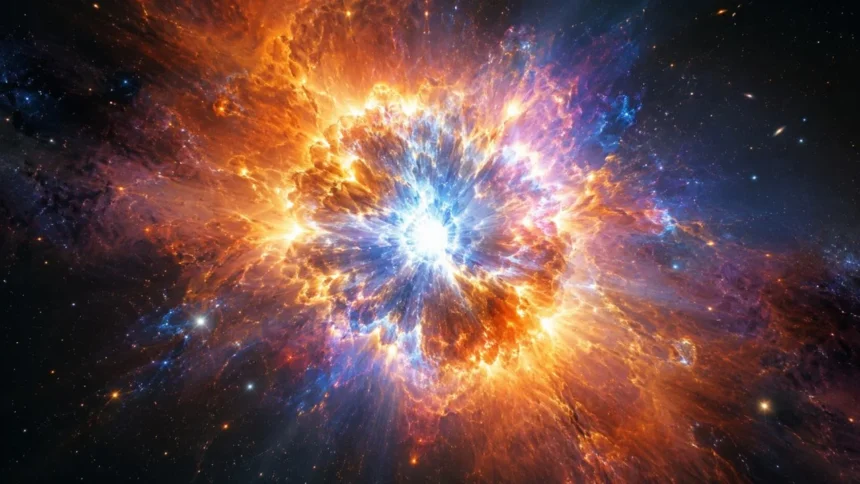
What Is a Supernova? Explore How Exploding Stars Transform Space
What Is a Supernova, and why does it produce one of the brightest events in the universe? A supernova is an enormous stellar explosion that can occur when a massive star reaches the end of its life or when a white dwarf becomes unstable in a binary star system.
During the explosion, a star can release tremendous energy and throw much of its material into surrounding space. Some supernovae briefly shine billions of times brighter than the Sun and may become bright enough to outshine the combined light of billions of stars in their host galaxy.
A supernova is not simply a larger version of an ordinary solar flare. It is a major event that destroys a white dwarf or tears apart the outer layers of a massive star. Depending on the explosion, the remaining core may become a neutron star or collapse further into a black hole.
These explosions also distribute oxygen, silicon, iron, calcium and other elements throughout space. That enriched material can later become part of new stars, planets and living organisms. Understanding supernovae therefore helps scientists explain both stellar death and the continuing development of galaxies.
Supernova Meaning
The word supernova describes a powerful explosion that causes a star’s brightness to rise sharply before gradually fading. The visible event may remain noticeable for weeks or months, while its expanding debris can continue glowing for thousands of years as a supernova remnant.
Not every star ends its life as a supernova. Lower-mass stars follow a gentler path, eventually releasing their outer layers and leaving behind dense white dwarfs. Stars considerably more massive than the Sun can instead experience a violent core-collapse explosion when their internal fuel is exhausted.
Another supernova pathway begins with a white dwarf, which is already the compact remnant of a Sun-like star. When conditions in a binary system make the white dwarf unstable, runaway nuclear reactions can destroy it in an event known as a Type Ia supernova.
The original star or star system that produces an explosion is called the progenitor. By examining the explosion’s light, chemical fingerprints and surrounding environment, astronomers can investigate what the progenitor was like before it disappeared or changed into a compact stellar remnant.
What Causes a Supernova?
There are two broad causes of supernovae. The first is the gravitational collapse of the core inside a massive star. The second is a thermonuclear explosion involving a white dwarf in a binary system, meaning it shares its environment with another orbiting star.
A massive star spends its life balancing two forces. Gravity pulls its material inward, while energy and pressure generated through nuclear fusion push outward. As long as the star can produce sufficient energy in its core, these opposing forces help it remain relatively stable.
When the core can no longer generate enough outward pressure, gravity gains the advantage. The centre collapses rapidly, creating extreme density and temperature. A powerful shock then travels through the surrounding layers and helps eject stellar material into space in a core-collapse supernova.
A white dwarf supernova does not begin with the same core-collapse process. Instead, transferred or merged material can create conditions for an uncontrolled nuclear reaction. The resulting thermonuclear explosion may completely destroy the white dwarf rather than leaving its original core intact.
How Does a Supernova Happen?
A high-mass star begins by converting hydrogen into helium through nuclear fusion. As it ages, it can fuse increasingly heavy elements in a series of internal layers. The star develops an onion-like structure, with lighter elements outside and heavier material located closer to its centre.
Eventually, the core becomes dominated by iron-group elements. Fusing iron does not provide the energy needed to support the star against gravity. Without an effective new energy source, the iron core becomes unstable and begins collapsing under the weight of the material above it.
The collapse can occur extremely quickly. Matter is compressed to extraordinary densities, and large numbers of protons and electrons are forced together. Neutrinos carry away most of the released energy, while the developing shock wave helps drive the star’s outer material into space.
The exact physics of reviving and sustaining the shock is complex, and researchers continue refining computer models of the process. However, observations clearly show that core-collapse supernovae eject fast-moving layers of gas while leaving behind either an extremely dense object or, in some cases, a black hole.
The Life of a Massive Star
Mass is the most important factor controlling how a star develops and dies. Massive stars use their nuclear fuel much faster than smaller stars because their cores reach higher temperatures and pressures. Consequently, some very massive stars survive for only a few million years before approaching their final stages.
During its lifetime, a massive star produces energy by joining lighter atomic nuclei into heavier ones. Hydrogen fusion is followed by later stages that can create helium, carbon, oxygen and progressively heavier elements. Each stage generally becomes shorter as the star approaches the formation of an iron-rich core.
Before exploding, the star may expand into a red supergiant or lose substantial material through powerful stellar winds. That lost gas can form shells around the star. When the supernova blast later reaches those shells, the collision may create bright rings, knots and other structures visible to telescopes.
Once fusion can no longer prevent the core from collapsing, the star reaches its final crisis. The resulting explosion sends newly formed and previously existing elements into the interstellar medium, where they may eventually contribute to another generation of stars and planetary systems.
Core-Collapse Supernovae
A core-collapse supernova occurs when a high-mass star can no longer support its centre. NASA generally associates this pathway with stars more than about eight times the mass of the Sun, although the precise outcome also depends on composition, mass loss, rotation and interactions with companion stars.
The collapse compresses the central material into a remarkably small region. The remaining core may stabilise as a neutron star, an object containing more mass than the Sun within a sphere roughly comparable in width to a city. More massive cores may continue collapsing into black holes.
At the same time, a shock wave ejects the star’s outer layers at very high speeds. These layers crash into gas and dust previously surrounding the star, heating the material and producing radiation across visible, infrared, radio, ultraviolet, gamma-ray and X-ray wavelengths.
Core-collapse events include supernova Types II, Ib and Ic. Astronomers distinguish them partly through the chemical absorption and emission lines detected in their spectra. Those spectral patterns reveal whether significant hydrogen or helium remained around the progenitor at the time of explosion.
Type Ia Supernovae
A Type Ia supernova begins with a white dwarf rather than the active core of a massive star. A white dwarf is the hot, compact remnant left after a lower-mass star has completed its main evolutionary stages and released much of its outer material.
One possible route involves a white dwarf pulling gas from a nearby companion. As the white dwarf gains material, its density and temperature increase until an instability triggers runaway fusion. The nuclear burning spreads rapidly and can completely disrupt the star.
A second possible route involves two white dwarfs orbiting one another. The objects can gradually spiral together and merge, potentially producing an explosion when their combined system becomes unstable. Astronomers continue investigating how frequently each pathway contributes to observed Type Ia events.
Type Ia supernovae are especially valuable because their peak brightness can be standardised and compared. By measuring how faint an explosion appears from Earth, astronomers can estimate its distance and use many such events to study how the expansion of the universe has changed.
Types of Supernova
Supernovae were historically classified by examining their spectra. A spectrum separates incoming light into different wavelengths and reveals chemical signatures. The first major distinction is whether the spectrum contains strong hydrogen lines, leading to the broad categories known as Type I and Type II.
Type II supernovae show hydrogen in their spectra and result from the core collapse of massive stars that retained substantial hydrogen-rich outer layers. Their brightness may remain relatively steady for a period or decline more continuously, allowing astronomers to divide them into additional subgroups.
Type Ib and Type Ic explosions are also core-collapse events, but their progenitors lost much of their outer material before exploding. Type Ib spectra lack strong hydrogen features but show helium, while Type Ic events show neither prominent hydrogen nor prominent helium lines.
Type Ia belongs to Type I because it lacks hydrogen lines, yet its cause differs from Types Ib and Ic. It is a thermonuclear white dwarf explosion rather than the collapse of a massive stellar core. This is why modern explanations group supernovae by both their spectra and their underlying physical causes.
How Bright Is a Supernova?
A supernova can become billions of times brighter than the Sun. From a sufficiently distant viewpoint, a single exploding star may temporarily rival or exceed the visible brightness of its entire host galaxy, even though that galaxy contains millions or billions of stars.
The explosion does not release all its energy as visible light. In a core-collapse event, most of the energy may escape through neutrinos, which are extremely light subatomic particles that interact only weakly with ordinary matter. A smaller fraction powers the moving debris and the brilliant electromagnetic display.
The observed brightness rises and fades according to the type of explosion, radioactive elements produced and surrounding material. As radioactive isotopes decay, they continue supplying energy to the expanding debris, helping the supernova remain visible after the initial shock has passed.
Distance also affects how bright an event appears from Earth. A highly powerful explosion in a remote galaxy may look like a faint point, while a closer event could become visible without a telescope. Astronomers therefore distinguish between apparent brightness and the object’s actual energy output.
How Long Does a Supernova Last?
The most violent physical changes inside a collapsing star happen very quickly. Core collapse can progress within seconds, while the shock may require additional time to travel through the star and emerge from its surface. The visible brightening then develops as expanding material releases and reprocesses energy.
The bright phase normally lasts much longer than the central collapse. A supernova can remain visibly prominent for weeks or months before gradually fading. Its exact light curve—the recorded change in brightness over time—helps astronomers identify the type of explosion and investigate its energy source.
After the main light fades, the event continues as an expanding supernova remnant. The ejected gas collides with the surrounding interstellar medium, producing shock-heated plasma that may glow strongly in radio waves, visible light and X-rays for thousands of years.
The remnant eventually spreads across a large region and slows as it collects surrounding material. Although the original explosion is brief on cosmic timescales, its influence can continue for hundreds of thousands of years through heating, chemical enrichment and the movement of interstellar gas.
What Happens After a Supernova?
The immediate aftermath depends on the explosion mechanism. A Type Ia supernova generally destroys its white dwarf progenitor, leaving no central version of the original star. A core-collapse supernova may leave a neutron star or black hole surrounded by rapidly expanding stellar debris.
The expelled gas travels outward and collides with material between the stars. This interaction creates forward and reverse shock waves that can heat the gas to millions of degrees. High-temperature remnants are therefore important targets for X-ray telescopes such as Chandra, XMM-Newton and XRISM.
Some neutron stars rotate rapidly and produce beams of radiation from regions near their magnetic poles. When those beams repeatedly sweep past Earth, astronomers detect regular pulses and call the object a pulsar. Other neutron stars possess especially strong magnetic fields and are known as magnetars.
The surrounding remnant continues carrying energy and chemical elements into the galaxy. Its shock waves can compress nearby interstellar clouds and may contribute to conditions that support future star formation, although the same radiation and turbulence can also disperse some clouds.
Neutron Star or Black Hole?
A neutron star forms when the collapsed core is dense enough to force electrons and protons together but can still resist complete gravitational collapse. It contains an extraordinary amount of mass in a sphere only around 20 kilometres across, depending on the individual object.
Neutron stars are among the densest known objects. Their magnetic fields can be enormously stronger than magnetic fields produced in laboratories, and some rotate hundreds of times each second. These properties make pulsars and magnetars valuable laboratories for studying matter under extreme conditions.
When the remaining core is too massive to be supported as a neutron star, gravity can continue compressing it into a black hole. A black hole contains matter within a region surrounded by an event horizon, beyond which not even light can escape.
Not every massive star produces the same outcome, and some may collapse into black holes with weak or unusual explosions. The result depends on the progenitor’s core, rotation, composition, mass loss and binary interactions, making stellar death an active area of astronomical research.
Supernova Remnants
A supernova remnant is the expanding structure left by an explosion. It contains material ejected from the star as well as interstellar gas collected by the outward-moving shock. These components may form bubbles, filaments, rings, knots and irregular shells.
Cassiopeia A is one of the best-known remnants in the Milky Way. The explosion’s light reached Earth roughly 350 years ago after travelling about 11,000 years through space. Modern Webb images show hot filaments, expanding material and surrounding light echoes across a structure roughly 20 light-years wide.
Researchers examine remnants at several wavelengths because each reveals different material and physical processes. Visible light may show glowing filaments, infrared instruments can detect warm dust, radio observations trace energetic particles, and X-rays reveal shock-heated gas containing highly energised atoms.
By mapping elements within a remnant, scientists can reconstruct the progenitor and explosion. Chandra observations of Cassiopeia A, for example, locate oxygen, silicon, sulfur, calcium and iron across the debris, providing evidence about nuclear reactions and the movement of material.
Elements Made by Supernovae
Stars produce many elements during their normal lifetimes. Hydrogen fusion creates helium, and massive stars continue through reactions that generate carbon, oxygen, neon, magnesium, silicon and iron-group material. The elements are arranged in different layers before the core collapses.
The explosion exposes these layers to intense heat, pressure and rapidly moving particles. New nuclear reactions occur, while elements created earlier are expelled into space. Supernovae are especially important for distributing iron and several other heavy elements throughout galaxies.
Not every element heavier than iron is produced mainly by ordinary supernovae. Events such as neutron-star mergers are important sources of some of the heaviest nuclei. The origin of each element depends on its nuclear structure and the temperatures, densities and neutron supplies available during different cosmic events.
The expelled material becomes mixed with clouds of gas and dust between stars. Those enriched clouds may later collapse and create new solar systems. The calcium in bones, iron in blood and oxygen around us are therefore connected to earlier generations of stars and stellar explosions.
Supernova vs Nova
A nova and a supernova may sound similar, but they are different events. A nova is an eruption on the surface of a white dwarf in a close binary system. Although the outburst may become very bright, it does not normally destroy either star.
A supernova is far more energetic and fundamentally changes or destroys its progenitor. In a Type Ia event, the white dwarf is disrupted by thermonuclear burning. In a core-collapse event, a massive star loses its outer layers and leaves a compact core or black hole.
Novae can occur more than once in the same system after the white dwarf collects another layer of material. Some are known as recurrent novae because astronomers have recorded multiple outbursts. A supernova, by contrast, is a one-time destructive event for the exploding star.
Supernovae are also considerably brighter. NASA explains that novae may become hundreds of thousands of times brighter than the Sun, whereas supernovae can reach billions of times the Sun’s brightness. This difference helps explain the “super” portion of the name.
Can the Sun Go Supernova?
The Sun will not become a supernova because it does not have enough mass to experience core collapse. Core-collapse explosions generally require stars considerably more massive than the Sun, commonly beginning at roughly eight solar masses under suitable conditions.
As the Sun exhausts its fuel, it will eventually expand into a red giant and release its outer material. The remaining centre will become a white dwarf. This transformation will be significant for the solar system, but it will not produce a massive supernova explosion.
A solitary white dwarf does not automatically become a Type Ia supernova. That explosion requires particular conditions involving a companion or merger. The future white dwarf left by the Sun is not currently expected to enter such a system because the Sun has no stellar companion.
Therefore, searches asking “Will the Sun explode?” require an important distinction. The Sun will change dramatically over billions of years, but it will not suddenly detonate as a supernova. Its final path will be much quieter than the death of a high-mass star.
What Does a Supernova Look Like?
From Earth, a distant supernova usually appears as a new point of light or a previously faint star-like object that has become much brighter. Because the explosion occurs extremely far away, viewers do not see a giant fireball expanding across the sky with the unaided eye.
Powerful telescopes can record how the point changes in brightness and colour. Spectrographs separate its light to reveal chemical signatures, speeds and temperatures. Comparing repeated observations enables astronomers to build a light curve and classify the event.
After the bright phase, larger telescopes may observe the expanding remnant. Images of Cassiopeia A show colourful filaments and shells, but the colours often represent particular wavelengths or chemical elements rather than exactly what human eyes would see from nearby.
Astronomers combine observations from several instruments to create a fuller picture. Radio, infrared, visible, ultraviolet, X-ray and gamma-ray measurements reveal different parts of the explosion, helping researchers examine dust, magnetic fields, shock waves, radioactive material and compact remnants.
How Scientists Find Supernovae
Modern surveys repeatedly photograph large sections of the sky. Computer systems compare new images with earlier observations and identify points that have changed in brightness. Promising candidates are then checked by additional telescopes to confirm that they are genuine astronomical events.
Spectroscopy is particularly important because different explosions can initially look similar. Chemical lines help determine whether hydrogen, helium, silicon and other elements are present. Their wavelengths may also reveal how rapidly the material is moving toward or away from Earth.
Space telescopes observe wavelengths that Earth’s atmosphere blocks or weakens. Hubble and Webb provide detailed optical and infrared data, while Chandra and XMM-Newton examine hot X-ray-emitting material. Missions such as Fermi investigate high-energy gamma rays connected with particularly powerful explosions.
Astronomers also study archival images taken before the explosion. When a telescope had previously photographed the same location, researchers may identify the progenitor star and compare its earlier properties with the supernova. Webb reported its first published detection of a supernova progenitor in 2026.
Why Supernovae Matter
Supernovae reveal how stars evolve, produce elements and interact with their surroundings. Studying different explosions enables astronomers to test models of nuclear fusion, gravity, magnetic fields, neutrino production and matter compressed to densities that cannot be reproduced easily on Earth.
Their remnants help researchers map the chemical development of galaxies. Each event returns enriched material to interstellar space, where it mixes with existing gas and may eventually become part of future stars, planets and biological systems.
Type Ia supernovae also provide a way to measure vast cosmic distances. Comparing their standardised brightness with how bright they appear helped astronomers discover that the expansion of the universe is accelerating, a finding now connected with the unresolved phenomenon called dark energy.
Future observatories will discover many more events and observe them earlier. Larger samples will improve measurements of cosmic expansion, while rapid follow-up studies may capture the first hours of stellar explosions and reveal how shock waves emerge from different progenitors.
Common Supernova Myths
One common myth is that every star will eventually explode. In reality, only particular massive stars experience core collapse, while white dwarfs require specific binary conditions to produce Type Ia events. Stars such as the Sun normally end as white dwarfs without becoming supernovae.
Another misunderstanding is that a supernova creates every heavy element by itself. Supernovae manufacture and distribute many important elements, but other cosmic processes—including neutron-star mergers—also contribute substantially to the production of heavy nuclei such as gold and related materials.
A third myth is that the complete star always becomes a black hole. Many core-collapse explosions instead leave neutron stars, while Type Ia supernovae generally destroy white dwarfs. The outcome depends on the progenitor, remaining core mass and explosion mechanism.
Finally, a supernova remnant is not the same as the original explosion. The supernova is the brief destructive event, while the remnant is the expanding gas, dust and shock-heated material left behind. A remnant can remain detectable long after the supernova light has faded.
Conclusion: Understand the Power of Exploding Stars
What Is a Supernova? It is the destructive explosion of certain stars, caused either by the collapsing core of a massive star or by runaway nuclear burning in an unstable white dwarf. These pathways differ, but both produce extraordinary energy and dramatic changes in their surroundings.
Core-collapse supernovae may leave neutron stars or black holes, while Type Ia events generally destroy their white dwarfs. The ejected material expands into space, producing remnants that allow astronomers to examine shock waves, chemical elements and the original explosion long afterward.
Supernovae also play a creative role in the universe. They release and distribute materials required for later generations of stars and planets. In that sense, a stellar death can help supply the ingredients from which entirely new systems eventually develop.
By studying their light, spectra, remnants and compact objects, scientists can investigate everything from nuclear physics to cosmic expansion. A supernova may begin with the destruction of one star, but its effects can influence its galaxy and scientific understanding for thousands of years.
Frequently Asked Questions
What is a supernova in simple words?
A supernova is an extremely powerful stellar explosion. It happens when a massive star’s core collapses or when a white dwarf becomes unstable and undergoes runaway nuclear burning.
What causes a star to become a supernova?
Massive stars explode when they run out of core fuel and gravity causes their centres to collapse. White dwarfs can explode after gaining or merging with enough material in a binary system.
What remains after a supernova?
A core-collapse supernova may leave a neutron star or black hole surrounded by expanding debris. A Type Ia explosion usually destroys its white dwarf and leaves no original stellar core.
Will the Sun become a supernova?
No. The Sun is not massive enough to experience core collapse. It will eventually release its outer layers and end its life as a white dwarf rather than exploding.
How often do supernovae happen?
NASA estimates that core-collapse supernovae occur approximately once every 50 years in the Milky Way, while Type Ia explosions may happen roughly once every 500 years.