
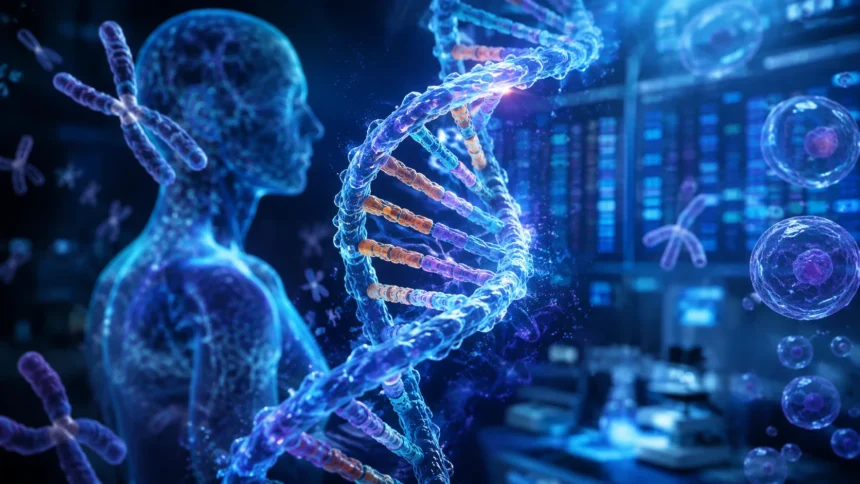
What Is the Human Genome? A Simple Guide to Our Genetic Blueprint
The human genome is the complete set of genetic information needed to build, maintain, and operate the human body. Most of this information is stored in DNA inside our cells, arranged across chromosomes and thousands of genes. Together, these genetic instructions influence development, biological functions, inherited traits, and many aspects of health.
You can think of the genome as an enormous biological instruction system rather than a simple blueprint with one instruction for every feature. Some DNA sequences contain genes that help make proteins, while other regions regulate when genes are active, help organize chromosomes, or perform functions scientists are still working to understand.
Nearly every cell in the body contains a copy of the genome, although different cells use different portions of that information. A brain cell and a muscle cell generally contain the same DNA, yet they behave differently because different genes are switched on or off and regulated in distinct ways.
Understanding what the human genome is has transformed biology and medicine. Genome sequencing now helps researchers study inherited diseases, cancer, human evolution, genetic variation, drug responses, and population history while opening new possibilities for precision medicine and more personalized approaches to healthcare.
What Is the Human Genome in Simple Terms?
The human genome is all of the DNA that makes up a person’s genetic information. DNA contains chemical instructions that cells use to grow, divide, communicate, repair themselves, and perform specialized functions throughout the body. These instructions are organized across chromosomes inside the nucleus of most cells.
A person’s genome contains roughly three billion DNA base pairs. These bases are represented by the letters A, T, C, and G, which stand for adenine, thymine, cytosine, and guanine. The specific order of these letters creates biological information that cells can interpret.
Some sections of DNA are genes, which contain information used to make functional molecules such as proteins or RNA. However, genes make up only a relatively small portion of the entire genome. Much of the remaining DNA has regulatory, structural, repetitive, or other biological roles.
The genome therefore contains far more than a list of genes. It includes gene-control regions, repeated sequences, structural DNA, and many other elements that influence how genetic information is organized and used. Scientists study all of these components to understand human biology more completely.
What Is DNA and How Does It Form the Genome?
DNA, or deoxyribonucleic acid, is the molecule that stores most human genetic information. It has a double-helix structure resembling a twisted ladder, with two strands connected by pairs of chemical bases. The sequence of those bases carries biological information.
The four DNA bases follow specific pairing rules. Adenine pairs with thymine, while cytosine pairs with guanine. These complementary relationships allow DNA to be copied accurately when cells divide, helping genetic information pass from one cell generation to the next.
DNA molecules are extremely long, so cells must package them efficiently. Proteins called histones help wrap and organize DNA into structures known as chromatin. During cell division, this material becomes highly condensed into visible chromosomes.
All of this DNA together forms the nuclear portion of the human genome. Humans also have a much smaller amount of DNA inside mitochondria, the structures that help cells generate energy. Mitochondrial DNA contributes additional genetic information beyond the chromosomes in the nucleus.
How Many Chromosomes Do Humans Have?
Most human body cells contain 46 chromosomes, organized into 23 pairs. One chromosome in each pair is usually inherited from the biological mother and the other from the biological father, giving most people two copies of most genetic regions.
Twenty-two of these chromosome pairs are called autosomes. The remaining pair is generally referred to as the sex chromosomes. Chromosome combinations vary among individuals and play roles in sexual development along with hormones, gene activity, and other biological factors.
Human egg and sperm cells usually contain only 23 chromosomes rather than 46. During fertilization, genetic material from the two reproductive cells combines, restoring the typical chromosome number in the resulting fertilized cell.
Chromosome number and structure matter because large changes can affect development and health. Missing chromosomes, extra chromosomes, duplicated sections, deleted regions, or rearrangements can alter gene dosage or function and may contribute to certain genetic conditions.
What Are Genes?
Genes are specific regions of DNA that contain instructions for producing functional biological products. Many genes help direct the production of proteins, which perform tasks ranging from building cellular structures to speeding up chemical reactions and carrying signals throughout the body.
Humans have roughly twenty thousand protein-coding genes, although the exact number depends partly on how genes are defined and classified. The relatively modest number surprised researchers because human biological complexity cannot be explained simply by counting genes.
A single gene can sometimes contribute to multiple biological products through processes such as alternative RNA splicing. Cells also regulate when genes are active, how strongly they are expressed, and which molecular versions are ultimately produced.
Genes therefore work as parts of complicated biological networks rather than isolated switches controlling one characteristic each. Traits such as height, metabolism, immune function, and disease risk can involve interactions among many genes as well as environmental and lifestyle factors.
Genes vs Genome: What Is the Difference?
A gene is one specific region of DNA with a particular biological function, while the genome refers to the complete collection of genetic material. In other words, genes are components of the genome rather than separate from it.
An easy comparison is to imagine a large reference library. Individual genes might resemble important entries or instructions within that library, while the genome represents the entire collection, including organizational information and sections that regulate how individual instructions are used.
This distinction matters because large portions of the human genome do not encode proteins. Regulatory sequences can influence when genes switch on and off, while repetitive and structural regions contribute to chromosome organization and genome stability.
Studying only genes therefore provides an incomplete picture of human genetics. Modern genomics examines genes together with regulatory DNA, structural variation, repetitive regions, gene interactions, and many other features that determine how the genome functions.
How Much DNA Is in the Human Genome?
A single set of human chromosomes contains roughly three billion DNA base pairs. Because most body cells contain two chromosome sets, they generally carry two copies of much of this genetic information, one inherited from each biological parent.
Despite containing billions of DNA letters, the human genome is remarkably similar from person to person. Most positions are shared across humans, while a smaller fraction varies and helps contribute to genetic differences among individuals and populations.
Those differences can include single-letter changes, small insertions or deletions, repeated sequences, and larger structural variations. Some have little or no observable effect, while others can influence physical characteristics, biological processes, or susceptibility to disease.
Genome size alone does not determine how biologically complex an organism is. Some plants and animals have genomes larger than the human genome. Biological complexity also depends on regulation, interactions among genes, RNA processing, cellular organization, and many other factors.
Why Is Most DNA Not Protein-Coding?
Only a small proportion of the human genome directly contains instructions for protein production. The remainder was once sometimes described too broadly as “junk DNA,” but scientists now understand that many noncoding regions have regulatory, structural, or other biological roles.
Some noncoding DNA controls when and where genes are activated. Enhancers, promoters, silencers, and other regulatory elements interact with proteins and chromatin structures to influence gene expression during development and throughout a person’s life.
Other regions produce functional RNA molecules that do not become proteins. These RNAs can participate in gene regulation, protein production, chromosome maintenance, and numerous additional cellular processes.
At the same time, not every stretch of noncoding DNA necessarily has an important biological function. The genome also contains repetitive sequences and remnants of ancient genetic events. Researchers continue investigating which regions are functional and how their roles differ among cell types.
What Is Genetic Variation?
Genetic variation refers to differences in DNA sequences among individuals. These differences are a normal part of human biology and help explain why people vary in appearance, physiology, metabolism, immune responses, and many other characteristics.
One common type of variation involves a change in a single DNA base, often called a single nucleotide variant. Other forms include insertions, deletions, copy-number changes, repeated sequences, and larger rearrangements affecting substantial portions of chromosomes.
Most genetic variants do not cause disease. Some have little measurable effect, while others influence harmless traits or slightly change biological function. A smaller number can significantly affect health or contribute to inherited genetic disorders.
Genetic variation also provides important information about human history. By comparing patterns across populations, scientists can investigate ancestry, migration, adaptation, population relationships, and evolutionary changes that occurred over thousands of generations.
Are All Human Genomes the Same?
Human genomes are overwhelmingly similar because all living humans belong to the same species and share relatively recent common ancestry. Most DNA sequences are therefore shared from person to person, providing the genetic foundation for common human anatomy and biology.
The small proportion that differs is still biologically important. Millions of genetic variants can distinguish one person’s genome from another, creating unique combinations inherited from previous generations and sometimes generated through new mutations.
Even identical twins can develop small genetic differences during life because mutations can occur as cells divide. Their genomes begin extremely similar, but changes can accumulate in different tissues over time.
Differences among people should also not be viewed as neat genetic boundaries between populations. Human genetic diversity overlaps extensively, and much variation exists within populations. Genetics reflects a complex history of migration, mixing, inheritance, and evolutionary change.
What Is a Mutation?
A mutation is a change in a DNA sequence. Mutations can occur when DNA is copied, through exposure to certain environmental factors, or because of normal biological processes taking place inside cells.
Some mutations occur in reproductive cells and can potentially be passed to children. Others arise in body cells during a person’s lifetime and remain limited to particular tissues or cell lineages rather than being inherited by future generations.
Many mutations have little effect because they occur in regions where the change does not significantly alter biological function. Some may be harmful, while occasionally a mutation can provide an advantage under particular environmental conditions.
Mutations are also an essential source of genetic variation and evolution. Without changes in DNA, populations would have far less new genetic diversity for natural selection and other evolutionary processes to act upon over generations.
What Was the Human Genome Project?
The Human Genome Project was a major international scientific effort created to determine the sequence of the human genome and identify its major genetic components. The project transformed genetics by giving researchers a shared reference for studying human DNA.
Scientists worked on sequencing billions of DNA bases, improving laboratory technologies, developing computational tools, and creating databases that could organize enormous amounts of genetic information. The project also encouraged discussion about the ethical and social implications of genomics.
The first major reference sequence dramatically accelerated research into genes, inherited disorders, genetic variation, evolution, and disease biology. However, early reference genomes still contained gaps because some repetitive and structurally complex regions were extremely difficult to sequence accurately.
Later advances in long-read sequencing and genome assembly helped researchers fill many of those missing regions. Modern genomics now goes beyond a single reference sequence by studying more complete genomes and broader genetic diversity across populations.
What Is a Complete Human Genome Sequence?
A complete human genome sequence aims to identify the order of DNA bases across chromosomes as accurately and continuously as possible. Early sequencing projects captured most accessible regions but struggled with repeated sequences, centromeres, and other technically challenging areas.
Improved sequencing technologies eventually allowed scientists to assemble previously unresolved sections. These developments provided a more detailed view of repetitive DNA, chromosome structure, duplicated genes, and regions that had remained missing from earlier references.
Having more complete genome sequences matters because previously inaccessible regions can contain medically and biologically relevant variation. They can also improve researchers’ ability to understand chromosome organization, inheritance, evolution, and certain genetic conditions.
Genome science continues to improve because no single sequence represents every human. Researchers increasingly compare many high-quality genomes to understand the full range of genetic variation rather than treating one reference genome as a perfect model of all humanity.
What Is the Human Pangenome?
The human pangenome is an approach designed to represent genetic diversity using genome sequences from many individuals rather than relying mainly on one linear reference. This gives researchers a broader picture of the DNA variants and structural differences present across human populations.
Traditional reference genomes have been extremely valuable, but any single reference necessarily represents only part of human genetic diversity. Certain variants can be difficult to detect accurately when a person’s DNA differs substantially from the reference sequence used for comparison.
A pangenome framework helps capture alternative sequences, insertions, deletions, duplications, and structural variants more effectively. This can improve genetic research and may eventually strengthen medical interpretation for people whose ancestry was poorly represented in older datasets.
The approach also highlights an important principle of modern genomics: there is no single sequence that perfectly defines the human genome for everyone. Humans share a common genetic foundation while carrying extensive individual and population-level variation.
How Do Scientists Sequence a Human Genome?
Genome sequencing begins by obtaining DNA from cells, often from blood, saliva, or another biological sample. Laboratory methods prepare the DNA so sequencing machines can read the order of its chemical bases.
Different technologies read DNA in different ways. Short-read sequencing produces many small fragments that computers assemble or compare against a reference, while long-read technologies can follow much longer DNA molecules and help resolve difficult repetitive or structural regions.
Powerful computers then process enormous quantities of sequence data. Bioinformatics software aligns sequences, identifies genetic variants, reconstructs genomic regions, and helps researchers compare an individual’s DNA with reference datasets or other genomes.
Sequencing the DNA is only the beginning. Interpreting what individual variants mean can be much harder, particularly for complex diseases influenced by many genes and environmental factors. Genomic medicine therefore depends on biological research as much as sequencing technology.
How Long Does Genome Sequencing Take?
The time required for genome sequencing has fallen dramatically since the earliest large-scale genome projects. Modern technologies can generate sequence data far faster than the methods available when scientists first attempted to map the complete human genome.
The total turnaround time still depends on the sequencing technology, laboratory workflow, amount of data required, quality controls, and the purpose of the test. Clinical genome sequencing may also require substantial time for interpretation after the raw DNA has been read.
Reading the sequence is only one step because laboratories need to identify potentially relevant variants and determine whether there is reliable evidence connecting them to a patient’s symptoms or medical question.
As sequencing becomes faster, interpretation remains one of the biggest challenges. The human genome contains millions of variants, and scientists do not yet understand the biological significance of every difference found in a person’s DNA.
How Does the Genome Affect Human Traits?
Genes influence many human characteristics, but the relationship between DNA and traits is often complicated. Some traits are strongly affected by variants in one gene, while many others result from contributions made by hundreds or thousands of genetic variants.
Height is a good example of a complex trait. Genetics plays a substantial role, but many genetic variants contribute small effects, and nutrition, health, hormones, and environmental conditions can also influence how tall a person ultimately becomes.
Genes can also affect characteristics such as pigmentation, metabolism, immune function, blood type, and responses to certain medicines. However, possessing a particular genetic variant rarely means a person’s entire biological outcome is predetermined.
The genome works together with environment, development, behavior, and chance. This interaction is why two people with similar genetic risk factors can experience different health outcomes and why genetic information must be interpreted within a broader biological context.
How Does the Human Genome Influence Disease?
Some diseases are caused largely by harmful variants in a single gene. Examples include certain inherited disorders where a specific genetic change disrupts an important protein or biological pathway and creates a relatively predictable disease pattern.
Many common conditions are more complex. Heart disease, type 2 diabetes, autoimmune disorders, and many cancers can involve numerous genetic variants interacting with age, environment, lifestyle, infections, and other biological factors.
Cancer provides a particularly important example of genome change because cancer cells accumulate mutations and other genetic abnormalities during a person’s lifetime. Studying tumor DNA can sometimes help doctors identify biological features that influence diagnosis or treatment decisions.
Genetics therefore often influences risk rather than destiny. A variant may increase or decrease the probability of developing a condition without guaranteeing an outcome. This distinction is essential when interpreting genetic tests and discussing inherited disease risk.
What Is Gene Expression?
Gene expression is the process through which information stored in DNA is used to produce functional molecules, including proteins and RNA. Cells control this process carefully so the correct genes are active at the right time and in the right tissues.
Nearly every cell contains essentially the same genome, yet liver cells, neurons, muscle cells, and skin cells perform completely different jobs. These differences arise largely because each cell type activates a different combination of genes.
Gene expression can change in response to development, hormones, nutrition, stress, environmental signals, infections, and many other influences. Regulatory proteins and chemical modifications help determine which genes become more or less active.
Understanding gene expression is central to modern biology because disease can occur even when the DNA sequence itself is unchanged. Abnormal gene regulation can alter cell behavior, making the control of genetic information just as important as the genetic code itself.
What Is Epigenetics?
Epigenetics refers to biological mechanisms that influence gene activity without necessarily changing the underlying DNA sequence. These mechanisms can help cells control which genes are available for use and how strongly particular genes are expressed.
Chemical modifications to DNA and histone proteins are important examples. These molecular marks can influence how tightly DNA is packaged, making some genomic regions more accessible to the cellular machinery involved in gene expression.
Epigenetic patterns play essential roles during development because cells with the same DNA need to become many different specialized tissues. They can also change in response to aging, environmental conditions, disease, and normal biological processes.
Epigenetics does not mean that every lifestyle experience permanently rewrites inherited biology. The field is complex, and not all epigenetic changes are passed between generations. Scientists carefully distinguish established mechanisms from exaggerated claims about controlling genes through everyday behaviors.
How Is the Human Genome Used in Medicine?
Genomic information can help doctors investigate some rare inherited diseases when traditional testing has not identified the cause. Sequencing may reveal a genetic variant that explains symptoms, helps confirm a diagnosis, or provides information relevant to family members.
Genomics is also increasingly important in cancer care. Tumor sequencing can identify mutations or molecular pathways that may help classify a cancer or determine whether certain targeted treatments are worth considering.
Another field, pharmacogenomics, examines how genetic differences influence responses to medicines. Some variants affect how quickly drugs are processed or how strongly a patient responds, which can sometimes help clinicians choose medications or doses more effectively.
These applications are part of precision medicine, which aims to use biological differences among individuals to improve healthcare decisions. Genomic information is valuable, but it is most useful when combined with symptoms, medical history, laboratory findings, and professional clinical judgment.
What Can Genetic Testing Tell You?
Genetic tests can answer different questions depending on what they examine. Some look for specific inherited conditions, while others assess carrier status, ancestry-related information, chromosome differences, drug-response variants, or selected health risks.
A genetic test does not automatically reveal everything about a person’s future health. Many diseases are influenced by complex combinations of genes and environment, meaning results may indicate increased probability rather than certainty.
Interpretation can also be challenging because scientists sometimes identify a variant of uncertain significance. This means a DNA difference has been detected, but there is not enough reliable evidence to determine whether it contributes to disease.
For medically important questions, genetic counseling can help people understand what a result does and does not mean. Context is particularly important when results could influence screening, treatment, reproductive decisions, or communication with family members.
Human Genome and Ancestry
DNA can contain information about biological ancestry because genetic variants are passed between generations. By comparing patterns across many individuals, researchers and ancestry services can estimate relationships between a person’s genome and reference populations.
These estimates are statistical rather than absolute labels. Human populations have migrated and mixed repeatedly throughout history, so genetic ancestry often reflects complex combinations rather than perfectly separated geographic categories.
Different ancestry companies may also produce somewhat different estimates because they use different databases, algorithms, geographic categories, and reference samples. Results can change as those datasets improve or become more representative.
Genome research has nevertheless provided extraordinary insight into human history. DNA studies have helped researchers explore ancient migrations, population expansions, mixing between groups, and genetic contributions inherited from ancient human relatives.
Can Your Genome Change During Your Lifetime?
The genome you inherit provides the basic genetic sequence present when development begins, but individual cells can acquire mutations throughout life. These changes occur during normal DNA replication and can also result from environmental exposures or cellular damage.
Most acquired mutations have little effect, particularly when they occur in DNA regions that do not significantly alter cell behavior. Others can damage important genes or regulatory pathways and may contribute to diseases such as cancer.
Because different cells acquire different mutations, a person’s body can gradually become a genetic mosaic containing slightly different DNA sequences across tissues. This means the genome is not perfectly identical in every cell throughout an entire lifetime.
However, these changes are generally very different from inherited genetic variation. Mutations occurring in ordinary body cells usually remain within that cellular lineage and are not passed to children unless changes involve reproductive cells.
Why Is Human Genome Research Important?
Human genome research helps scientists understand the basic biology underlying development, health, and disease. By identifying genes, regulatory elements, genetic variants, and chromosome structures, researchers can investigate why biological processes work normally and what changes when disease occurs.
It also helps reveal why people respond differently to the same illness or medication. Some of these differences have genetic components, making genomics increasingly relevant to disease risk assessment, diagnosis, pharmacology, and personalized medical research.
Genome studies also provide insight into human evolution and population history. Comparing DNA within humans and across species can reveal shared ancestry, evolutionary adaptations, migration patterns, and genetic changes that occurred over long periods.
Perhaps most importantly, genomics continues to show how complex biology really is. The genome is not a simple instruction manual where each gene produces one outcome. It is an interconnected information system influenced by regulation, environment, development, and countless molecular interactions.
What Are the Ethical Issues Around Human Genomics?
Genomic information can be deeply personal because DNA may reveal information about inherited disease risk, biological relationships, and family members who share some of the same genetic variants. Privacy is therefore one of the major ethical considerations surrounding genomic data.
Consent also matters. People providing DNA for medical testing or research should understand how their information may be stored, analyzed, shared, or reused. Clear policies are increasingly important as large genomic databases become valuable tools for scientific discovery.
Fair representation is another issue. Historically, some genomic datasets have included more participants from certain ancestry groups than others. Improving diversity can make research findings and potential medical benefits more relevant to broader populations.
Society must also consider how genetic information is communicated. Genes can influence traits and health risks, but they do not determine a person’s value, ability, identity, or destiny. Responsible genomics requires both scientific accuracy and careful treatment of social consequences.
The Future of Human Genome Research
Human genomics is moving toward more complete and diverse representations of genetic variation. Better sequencing technologies can read previously difficult regions and identify structural differences that older approaches sometimes missed.
Researchers are also integrating genome data with information about RNA, proteins, epigenetics, cells, and environmental exposures. Combining these layers can provide a more realistic picture of how biological systems operate than DNA analysis alone.
Artificial intelligence and advanced computational methods are increasingly useful for identifying patterns in enormous genomic datasets. These tools may help researchers predict the effects of some variants, discover disease mechanisms, and identify possible therapeutic targets.
The long-term goal is not simply to sequence more genomes but to understand them better. As interpretation improves, genomic science may support earlier diagnoses, more targeted therapies, improved drug development, and deeper understanding of what makes human biology both shared and individually variable.
Final Thoughts: What Is the Human Genome?
The human genome is the complete collection of genetic information contained in human DNA. It includes genes, regulatory regions, repetitive sequences, chromosome structures, and many other elements that work together to guide development and cellular function.
Most human cells carry 46 chromosomes containing billions of DNA base pairs. Within this vast sequence are roughly twenty thousand protein-coding genes along with numerous noncoding regions that influence how genetic information is organized and expressed.
Human genomes are remarkably similar but not identical. Genetic variation contributes to differences among individuals and populations while providing information about health, ancestry, evolution, and biological diversity.
Understanding the human genome has changed modern science, yet researchers are still uncovering how its many components interact. The genome is not simply a fixed instruction book; it is part of a dynamic biological system shaped by gene regulation, development, environment, and evolution.
Frequently Asked Questions
What is the human genome in simple words?
The human genome is the complete set of DNA instructions found in a person. It includes genes and other DNA regions that help control how cells develop, function, and maintain the body.
How many genes are in the human genome?
Humans have roughly 20,000 protein-coding genes. However, genes represent only a small portion of the genome, which contains billions of DNA base pairs and many regulatory regions.
How many chromosomes are in the human genome?
Most human body cells contain 46 chromosomes arranged into 23 pairs. Typically, one chromosome from each pair comes from the biological mother and the other from the biological father.
Is everyone’s human genome the same?
Human genomes are overwhelmingly similar, but millions of DNA variants create differences among individuals. These variations can influence traits, ancestry, drug responses, and certain health risks.
Why is the human genome important?
The human genome contains the genetic information needed for human development and cellular function. Studying it helps scientists understand inheritance, disease, evolution, genetic variation, and potential new medical treatments.