
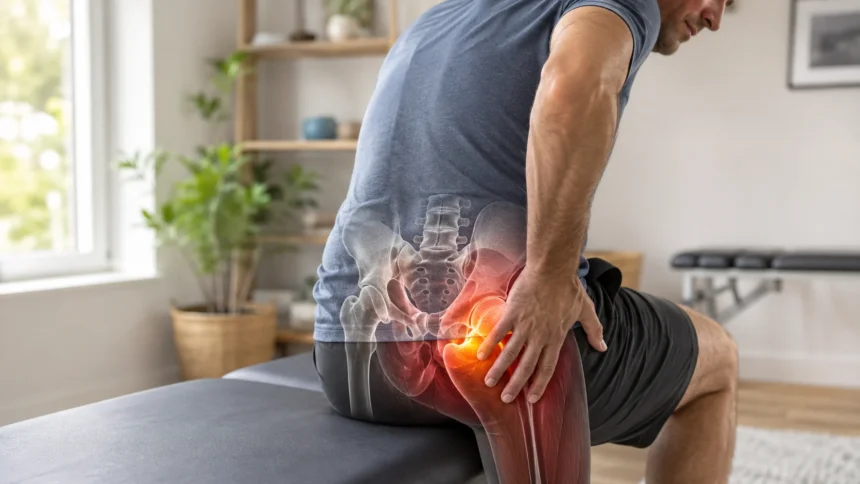
Ischial Tuberosity: What It Is and Why It Hurts
If sitting on a hard chair produces a deep ache at the bottom of your buttock, the discomfort may be coming from an area called the ischial tuberosity. Often described as your “sit bone,” this strong part of the pelvis supports body weight when you sit and provides an important attachment point for muscles and ligaments.
The area also serves as the origin of most of the hamstring muscles. Because these muscles generate force during running, walking, bending, climbing, and other movements, the tissues surrounding the ischial tuberosity can experience considerable stress. Problems involving the hamstring tendon, nearby bursa, bone, or surrounding nerves may therefore cause pain in almost the same location.
Ischial tuberosity pain is especially noticeable when sitting because body weight directly compresses the area against the seat. Some people experience only sitting pain, while others notice symptoms during running, stretching, squatting, walking uphill, or bending forward. The pattern provides useful clues but does not diagnose the cause by itself.
Fortunately, many common causes can improve with activity modification and appropriately progressed rehabilitation. Sudden severe pain, major bruising, weakness, neurological symptoms, or persistent unexplained pain deserves medical evaluation because injuries around the sit bone can range from relatively minor irritation to significant hamstring tendon tears.
What Is the Ischial Tuberosity?
The ischial tuberosity is a thick, rounded part of the ischium, one of the bones that helps form each side of your pelvis. You have two ischial tuberosities—one beneath each buttock—and they can often be felt as firm bony areas when you sit on a hard surface.
These structures are commonly called the sit bones or sitting bones because they bear a significant portion of your body weight when you sit upright. The amount of pressure changes according to your posture, chair surface, body position, and the amount of soft tissue between the bone and seat.
The sit bone is much more than a pressure-bearing structure. It provides important attachment sites for muscles and connective tissues that contribute to hip movement, knee control, pelvic stability, and normal walking. This makes it mechanically important during both everyday movement and athletic activity.
Its location also places it close to other structures capable of producing similar symptoms. The hamstring tendons, ischial bursa, sciatic nerve, nearby muscles, and ligaments all occupy the lower buttock region, which is why accurately identifying the source of pain near the ischial tuberosity can sometimes require a detailed examination.
Where Is the Ischial Tuberosity Located?
The easiest way to understand the location is to think about where your weight contacts a firm chair. The two hard points underneath the lower buttocks are your ischial tuberosities. They sit near the bottom and back portion of the pelvis rather than in the center of the gluteal muscles.
When you stand, the gluteus maximus covers much of this region. As you bend the hip to sit, the relationship between the muscles and bone changes, leaving the tuberosities positioned to support more of your body weight against the surface below.
The proximal hamstring tendons attach very close to these bony points. The semitendinosus, semimembranosus, and long head of the biceps femoris originate from the ischial tuberosity before traveling down the back of the thigh.
The sciatic nerve also travels through the broader deep buttock region near the proximal hamstring origin. Because several important structures occupy such a small area, pain felt directly under the buttock may originate from bone, tendon, bursa, nerve, or occasionally another nearby structure.
What Muscles Attach to the Ischial Tuberosity?
Most of the major hamstring muscles attach proximally to the ischial tuberosity. These include the semitendinosus, semimembranosus, and long head of the biceps femoris. The short head of the biceps femoris is different because it originates from the femur rather than the pelvis.
These muscles perform several important movements. The hamstrings help extend the hip, particularly when bringing your thigh backward or rising from a bent position, and they help flex the knee. They also contribute to controlling and stabilizing your legs during walking and running.
A portion of the adductor magnus also attaches to the ischial tuberosity and contributes to hip extension. Ligament attachments in the area add another layer of structural support, making the region an important junction between the pelvis and lower limb.
Because strong muscles transmit force through their tendons into the bone, the hamstring origin at the ischial tuberosity experiences considerable mechanical loading. Repetitive loading can be healthy and strengthening when appropriately progressed, but sudden excessive force or insufficient recovery can irritate or injure these tissues.
Why Does the Ischial Tuberosity Hurt?
The bone itself is not always the structure causing pain. In many cases, discomfort comes from tissues attached to or positioned beside the ischial tuberosity. The proximal hamstring tendon and ischial bursa are two common sources of localized lower-buttock pain.
Repeated compression can also contribute. When you sit, especially on a firm surface, body weight places direct pressure over the sit bones and surrounding tissues. A structure that is already irritated may therefore become considerably more painful during prolonged sitting.
Athletic activity creates another type of load. Running, sprinting, lunging, squatting, kicking, and rapid changes of direction require the hamstrings to absorb and generate force. A sudden overload can cause a strain or tear, while repeated loading over time can contribute to proximal hamstring tendinopathy.
Not every ache in this area originates locally. Lower-back conditions, sciatic nerve irritation, deep gluteal problems, hip disorders, pelvic conditions, and other injuries can create pain that feels as though it originates near the ischial tuberosity, making persistent symptoms worth evaluating carefully.
Proximal Hamstring Tendinopathy: A Common Cause of Sit Bone Pain
Proximal hamstring tendinopathy involves pain and reduced load tolerance in the hamstring tendons where they originate near the ischial tuberosity. It commonly develops gradually rather than following one dramatic injury, although a previous hamstring strain can sometimes contribute.
The characteristic symptom is a deep ache near the lower buttock that becomes uncomfortable during prolonged sitting. Running—particularly faster running or uphill running—may also reproduce symptoms, as can deep squatting, lunging, bending forward, or activities involving substantial hip flexion.
Both active and relatively sedentary people can experience the problem. Runners are commonly affected because the hamstrings repeatedly handle large forces, but prolonged sitting and sudden changes in training or activity can also make the tendon region more sensitive.
Treatment usually focuses on managing tendon load and progressively rebuilding strength rather than completely avoiding movement. Recovery can take time because tendons adapt gradually, and repeatedly testing the painful movement or progressing exercise too quickly can keep the area irritated.
What Does Proximal Hamstring Tendinopathy Feel Like?
Pain usually sits directly beneath the buttock around the hamstring attachment rather than in the middle of the hamstring muscle. Some people can point to the painful spot with one finger, while others describe a slightly broader ache extending into the upper posterior thigh.
Sitting is often particularly uncomfortable. Car seats, office chairs, airplanes, cycling positions, or benches can become irritating because hip flexion and direct pressure increase compression around the proximal hamstring tendon and sit bone.
Exercise symptoms often have a recognizable pattern as well. Faster running, hills, long strides, deadlifts, deep squats, lunges, and aggressive hamstring stretching may aggravate the area because these activities increase tensile or compressive demands on the proximal tendon.
The discomfort is commonly gradual and persistent rather than associated with a single loud pop. In contrast, sudden severe upper hamstring pain, bruising, and immediate weakness after an explosive movement may indicate an acute strain or tendon tear rather than typical chronic tendinopathy.
Ischial Bursitis: Another Cause of Pain When Sitting
A bursa is a small fluid-containing structure that reduces friction where tissues move against one another. The ischial bursa lies near the ischial tuberosity and can become irritated, producing a condition known as ischial bursitis.
Ischial bursitis often creates a deep, localized ache around the sit bone. Prolonged sitting, particularly on hard surfaces, can worsen symptoms because pressure is repeatedly applied to the irritated area. Tenderness when touching the lower buttock may also occur.
Historically, this condition has sometimes been called “weaver’s bottom,” reflecting occupations in which people spent long periods sitting on firm surfaces. Modern desk work, cycling, prolonged driving, trauma, or other repeated pressure may produce similar mechanical irritation.
Ischial bursitis can resemble proximal hamstring tendinopathy because the ischial bursa and hamstring tendon sit close together. A clinician may need to examine how symptoms respond to pressure, muscle contraction, stretching, and movement to determine which structure is more likely involved.
Is It Ischial Bursitis or Hamstring Tendinopathy?
Both conditions can create pain near the sit bone and become worse during prolonged sitting, making self-diagnosis difficult. However, hamstring tendinopathy is often more clearly aggravated when the hamstrings must produce force or tolerate load.
Running, lunging, deadlifting, walking uphill, and resisted knee flexion may therefore point more strongly toward the hamstring tendon. Deep hip flexion and hamstring stretching can also increase tendon compression and reproduce familiar symptoms.
Ischial bursitis may be especially sensitive to direct pressure. Someone may describe difficulty sitting on a hard chair and localized tenderness without experiencing the same degree of discomfort during resisted hamstring activity, although considerable overlap is possible.
Neither pattern is perfectly diagnostic. A healthcare professional can assess sit bone pain when sitting, examine strength and mobility, palpate the region, and determine whether imaging is appropriate when symptoms are severe, unusual, or failing to improve.
Can a Hamstring Strain Cause Ischial Tuberosity Pain?
Yes. The hamstrings originate from the ischial tuberosity, so a strain involving the upper portion of the muscle-tendon unit can produce pain close to the sit bone. These injuries are particularly associated with sprinting, rapid acceleration, jumping, and forceful stretching.
A mild strain may cause localized pain, stiffness, and discomfort when contracting or stretching the hamstrings. More significant injuries can produce swelling, weakness, difficulty walking normally, and bruising extending down the back of the thigh.
The timing provides an important clue. Unlike tendinopathy, which frequently develops gradually, a proximal hamstring strain often begins during a recognizable event. An athlete may feel a sudden sharp sensation while sprinting or stretching the leg rapidly.
Early management depends on injury severity. Avoid aggressively stretching a newly injured hamstring simply because it feels tight, as stretching can place additional stress on healing tissue. Gradual rehabilitation and progressive strengthening are typically introduced as symptoms and tissue healing allow.
What Is a Proximal Hamstring Tendon Avulsion?
A proximal hamstring avulsion is a more serious injury in which one or more hamstring tendons partially or completely pull away from their attachment at the ischial tuberosity. In some injuries, a small piece of bone may also be pulled away.
This often occurs during a forceful movement that suddenly stretches the hamstrings while they are contracting. Falls, waterskiing injuries, sprinting, slipping, and sports involving extreme hip flexion with the knee extended can create this type of mechanism.
Symptoms can include a sudden severe pain near the buttock, a popping sensation, extensive bruising, weakness, and difficulty walking. Significant tendon retraction may produce more substantial loss of strength than a routine muscle strain.
Suspected avulsions require medical evaluation because some complete or significantly retracted tears may need surgical consideration. The decision depends on which tendons are involved, how far they have retracted, functional demands, symptoms, and individual clinical factors.
Can Teenagers Injure the Ischial Tuberosity?
Adolescents can develop a somewhat different injury because their growing skeleton contains areas where tendons attach near developing bone. During powerful muscle contraction, the tendon may sometimes pull a piece of bone away rather than tearing in the same pattern commonly seen in adults.
This is known as an ischial tuberosity avulsion fracture. It can occur during sprinting, jumping, kicking, gymnastics, or other activities that suddenly place high tension through the hamstrings.
The injury may cause abrupt pain beneath the buttock, difficulty walking, tenderness, swelling, or bruising. Because it can resemble a hamstring strain, young athletes with substantial pain after a sudden explosive movement should be assessed rather than assuming they have simply pulled a muscle.
Imaging such as an X-ray may be used to identify the bone injury. Treatment depends on displacement and severity, with many cases treated without surgery while larger or problematic avulsions may require specialist assessment.
Why Does the Ischial Tuberosity Hurt When Sitting?
When you sit, your body weight transfers directly onto the ischial tuberosities. A firm chair creates greater focal pressure than a well-padded surface, which is why lower-buttock pain may feel significantly worse on wooden benches, hard office chairs, or similar seating.
Sitting also places the hips in flexion. This position can increase compression around the proximal hamstring tendon, particularly when the hips are deeply flexed or the person remains seated for an extended period.
This combination of direct pressure and hip position helps explain why proximal hamstring tendinopathy and ischial bursitis frequently cause sitting problems. Long drives can be especially irritating because you experience pressure while having limited opportunities to change position.
However, sitting pain alone does not establish which structure is involved. If symptoms persist, examining when pain appears during movement, walking, running, bending, stretching, and muscle contraction can help a healthcare professional narrow the diagnosis.
Can Sitting Too Long Cause Sit Bone Pain?
Long periods of sitting can increase pressure around the ischial tuberosity and may aggravate tissues that are already sensitive. Someone who recently increased desk work, driving, cycling, or travel may therefore notice a gradual increase in buttock pain from sitting.
That does not mean sitting is inherently damaging. Human tissues are capable of tolerating sitting, and many people sit for long periods without developing ischial tuberosity pain. Problems are more likely when tissue capacity and the amount of repeated loading no longer match.
Changing position regularly can reduce continuous pressure. Standing for a few minutes, walking briefly, adjusting seat height, or alternating between different working positions can be more practical than trying to maintain one supposedly perfect posture all day.
If sitting repeatedly provokes pain, simply forcing yourself to tolerate increasingly longer periods may not be useful. Temporarily adjusting exposure while gradually rebuilding tissue capacity can help create a better balance between avoiding excessive irritation and becoming unnecessarily inactive.
Can Sciatica Cause Pain Near the Ischial Tuberosity?
The sciatic nerve travels through the deep buttock and down the back of the leg, relatively close to the proximal hamstring origin. This means nerve-related pain can sometimes be experienced in an area similar to hamstring tendon or sit-bone pain.
Sciatic pain is more likely to include radiating symptoms rather than remaining confined to one small point. Burning, electric, shooting, numb, or tingling sensations traveling down the posterior thigh or farther into the leg can suggest neurological involvement.
The source may sometimes be the lower back, while other forms of nerve irritation can occur within the deep gluteal region. Importantly, not every pain traveling down the back of the thigh is automatically sciatica, and not every localized buttock ache comes from the hamstring tendon.
A neurological examination can help distinguish these possibilities. Changes in reflexes, sensation, muscle strength, or nerve-tension testing may guide further assessment when symptoms suggest that nerves rather than only local soft tissues are involved.
What Else Can Mimic Ischial Tuberosity Pain?
Posterior buttock pain has a broad differential diagnosis. In addition to hamstring tendinopathy, ischial bursitis, strains, and nerve irritation, symptoms can sometimes originate from the lumbar spine, sacroiliac region, hip joint, or surrounding muscles.
Deep gluteal conditions can produce pain that resembles proximal hamstring pain, particularly when symptoms radiate into the posterior thigh. Ischiofemoral impingement and problems involving nearby ligaments or other tendons can occasionally create overlapping symptoms as well.
Bone-related problems are less common but important. Stress injuries, avulsion injuries, infection, and tumors are unusual causes of localized pelvic pain but become relevant when the history or symptoms do not match a typical overuse problem.
This is why chronic pain should not always be reduced to one popular diagnosis seen online. A proper examination considers where the pain is located, how it started, what movements provoke it, neurological symptoms, injury history, training changes, and general health.
How Is Ischial Tuberosity Pain Diagnosed?
Diagnosis normally begins with a conversation about when the pain started and what makes it better or worse. A gradual ache associated with sitting and running suggests a different problem from sudden severe pain and bruising following an explosive sprint.
The clinician may press around the ischial tuberosity and assess hamstring strength, hip movement, flexibility, gait, and neurological function. Resisted knee flexion or particular positions that load the proximal hamstrings may help reproduce tendon-related symptoms.
The lower back and hip may also be examined because pain can be referred from nearby regions. The goal is not simply to find one tender spot but to determine whether the overall symptom pattern matches a specific structure.
Many cases can initially be assessed clinically without extensive testing. Imaging becomes more useful when symptoms are severe, the diagnosis remains uncertain, a significant tear or bone injury is suspected, or the problem fails to improve as expected.
Do You Need an MRI or Ultrasound?
An MRI can provide detailed views of the proximal hamstring tendons, surrounding soft tissue, bone, and nearby structures. It may show tendon thickening, partial tearing, edema, or more significant hamstring injuries when clinically relevant.
Diagnostic ultrasound can also visualize the proximal hamstring region and may identify changes involving tendons or the ischial bursa. It has the advantage of allowing real-time examination and comparison while being less expensive or more accessible in some healthcare settings.
X-rays are particularly helpful when a bone injury is suspected, such as an avulsion fracture in a young athlete. They do not show tendons as clearly as MRI but can reveal important abnormalities involving the ischial tuberosity itself.
Imaging findings must be interpreted alongside symptoms. Tendons can sometimes show structural changes on scans without producing pain, so seeing an abnormality on MRI does not automatically prove it is the source of the patient’s symptoms.
How Is Ischial Tuberosity Pain Treated?
Treatment depends on what is actually causing the pain. Proximal hamstring tendinopathy generally requires a different rehabilitation strategy from an acute tendon avulsion, and ischial bursitis may require greater emphasis on reducing direct pressure.
For many gradual-onset tendon problems, education and progressive exercise are central. Rather than resting indefinitely, rehabilitation gradually exposes the hamstrings and surrounding muscles to enough resistance to improve their ability to tolerate everyday and athletic loads.
Temporary activity modification may be necessary. A runner might reduce speed sessions or hills for a period, while someone whose pain is dominated by sitting may adjust seating and take more frequent standing breaks while the irritated tissue settles.
Treatment should eventually address the activity you want to return to. Simply making pain disappear at rest is not the same as rebuilding enough strength and capacity for running, lifting, cycling, or sitting through a full workday comfortably.
Should You Rest Ischial Tuberosity Pain?
A short reduction in aggravating activity can be useful when pain has recently flared, but complete rest for long periods is rarely the ideal solution for most overuse tendon conditions. Excessive inactivity can reduce strength and make returning to normal loading more difficult.
The better goal is often relative rest or load modification. You reduce activities that repeatedly provoke significant pain while keeping movements that remain comfortable and gradually building tolerance again.
For example, you might temporarily shorten runs, avoid steep hills, reduce deadlift loads, or change sitting habits rather than stopping all exercise. The appropriate modification depends on the exact condition and severity.
Acute injuries are different. If a sudden event caused severe pain, bruising, or weakness, avoid testing the hamstring repeatedly and seek appropriate evaluation before deciding that ordinary tendinopathy rehabilitation is suitable.
Should You Stretch a Painful Hamstring?
Stretching is often the first response to anything that feels tight, but aggressive hamstring stretching may aggravate proximal hamstring tendinopathy. Deep hip flexion combined with knee extension can increase compression and tension at the tendon attachment near the ischial tuberosity.
Someone may therefore notice temporary relief while stretching but increased sitting or running pain later. This does not mean hamstring flexibility is unimportant; it means the dose and timing of stretching should match the condition being treated.
Gentle movement that does not significantly reproduce symptoms may be appropriate, particularly during rehabilitation. However, repeatedly forcing a painful end-range stretch is not required for the tendon to recover.
If flexibility is genuinely limited, a physical therapist can determine whether the hamstrings themselves need mobility work or whether another factor is producing the feeling of tightness. A sensation of tension does not always mean a muscle needs to be stretched harder.
What Exercises Help Proximal Hamstring Pain?
Early rehabilitation may include isometric hamstring exercises, bridges, or other controlled movements that allow the muscles to produce force without exposing the painful tendon to excessive compression. The exact starting point depends on symptoms and current strength.
As tolerance improves, resistance can gradually increase through exercises such as bridges, hamstring curls, Romanian deadlifts, hip hinges, or other progressive strengthening movements. Slow, controlled loading can help build tendon and muscle capacity over time.
Later stages should resemble the person’s goals. A runner may eventually need faster hamstring loading, hills, and progressive running exposure, while someone whose main goal is comfortable daily activity may require less sport-specific intensity.
Progression should be based on response rather than a fixed online timetable. Mild discomfort may sometimes be acceptable during tendon rehabilitation, but worsening pain that persists after exercise can indicate that the current loading dose is too aggressive.
How Can You Make Sitting More Comfortable?
Start by reducing direct pressure on the painful area. A supportive seat cushion can be helpful, although extremely soft surfaces are not automatically better because they may alter hip position or allow the body to sink deeply.
Changing position frequently can be equally important. Instead of sitting continuously for several hours, briefly stand, walk, or alter your working position before discomfort becomes severe. Short changes performed consistently may be easier than waiting for significant pain.
Seat height can affect hip flexion. A chair that leaves your knees substantially higher than your hips may place you in deeper hip flexion, which can increase compression around the hamstring origin in some people.
Avoid becoming dependent on one perfect posture. Your body is designed to move through different positions, so variation is generally more practical than rigidly holding one posture. The goal is gradually restoring comfortable sitting capacity rather than permanently avoiding sitting.
Can a Cushion Help Ischial Tuberosity Pain?
A cushion may temporarily decrease direct pressure over the sit bones and improve comfort, particularly when ischial bursitis or sitting-related tendon compression is suspected. This can be helpful during driving, office work, or other unavoidable sitting.
Cushion design matters. Some people prefer firm supportive foam, while others benefit from cushions designed to reduce pressure beneath the ischial tuberosities. An extremely unstable cushion can create different problems if it makes sitting uncomfortable or awkward.
A cushion should usually be considered a symptom-management tool rather than the entire treatment. If a tendon lacks capacity for everyday loading, reducing pressure alone will not necessarily rebuild strength or return someone to running and other activities.
The long-term goal is generally to improve tissue tolerance while using practical modifications during recovery. If you require increasingly elaborate seating adjustments just to tolerate a few minutes of sitting, the underlying cause deserves assessment.
Do Injections Help Ischial Tuberosity Pain?
Injections may be considered in selected cases, but their role depends on the diagnosis. A clinician might use an image-guided injection around an inflamed bursa or another targeted structure when conservative management has not provided sufficient relief.
Corticosteroid injections can sometimes reduce inflammation-related pain, but repeated steroid exposure around tendons requires caution because corticosteroids can affect tendon tissue. Decisions about injections should therefore consider both potential short-term relief and longer-term tissue health.
Platelet-rich plasma (PRP) and other procedures have also been studied for proximal hamstring tendinopathy, but evidence has not established a universally superior intervention. Marketing claims often sound more confident than the clinical research supports.
Most people with gradual-onset proximal hamstring tendinopathy should not assume an injection is necessary before trying an appropriately structured rehabilitation program. Procedures become more relevant when symptoms remain disabling despite reasonable conservative management and the diagnosis has been carefully established.
When Is Surgery Needed?
Most uncomplicated hamstring strains, cases of ischial bursitis, and many instances of proximal hamstring tendinopathy are managed without surgery. Conservative treatment generally receives substantial time because tendons and surrounding tissues can improve gradually.
Surgery becomes more relevant with complete proximal hamstring tendon avulsions, particularly when multiple tendons have detached and retracted or substantial functional weakness is present. Timing and surgical indications depend on the specific injury and patient.
Rare cases of chronic tendon problems that remain severely disabling despite extensive nonoperative management may also be referred to a specialist. Surgery for persistent tendinopathy is considerably less common than rehabilitation-based care.
If surgery is required, recovery usually involves a structured rehabilitation period rather than an immediate return to normal activity. Proximal hamstring repairs can require many months of recovery before full athletic activity is appropriate.
When Should You See a Doctor for Ischial Tuberosity Pain?
Arrange an assessment when pain persists for several weeks, repeatedly returns, progressively worsens, or prevents normal sitting, walking, exercise, work, or sleep. Early evaluation can be helpful when the diagnosis remains unclear.
Seek more urgent evaluation following a sudden injury accompanied by a pop, severe buttock pain, substantial bruising, marked weakness, or difficulty walking. These features can indicate a significant hamstring tear or avulsion injury.
Neurological symptoms also deserve attention. Persistent numbness, tingling, significant leg weakness, or pain extending far down the leg may indicate nerve involvement rather than a simple local tendon problem.
Emergency assessment is appropriate for symptoms such as new loss of bladder or bowel control, numbness around the groin or saddle region, rapidly progressing leg weakness, serious trauma, or severe pain accompanied by other concerning systemic symptoms.
How Can You Prevent Ischial Tuberosity and Hamstring Problems?
There is no guaranteed way to prevent every injury, but gradually building hamstring and hip strength improves the body’s capacity to tolerate physical demands. Sudden increases in sprinting, hills, lifting, or training volume can be harder for tissues to manage than gradual progression.
Strength training can include hip hinges, Romanian deadlifts, hamstring curls, bridges, and other exercises suited to your ability. Athletes may also benefit from more specific high-speed or eccentric hamstring work as their training progresses.
Recovery matters as well. Hard training creates stress that the body needs time to adapt to, so sleep, nutrition, appropriate rest, and sensible scheduling contribute to a sustainable program.
For people who sit for long periods, simple movement variety can reduce continuous pressure. Stand periodically, walk when practical, adjust your workspace for comfort, and maintain regular physical activity rather than expecting one ideal chair or posture to prevent every problem.
The Bottom Line on Ischial Tuberosity Pain
The ischial tuberosity is the strong bony prominence beneath each buttock commonly known as a sit bone. It supports body weight while sitting and serves as an important attachment site for the hamstrings and other structures.
Pain in this region does not necessarily mean the bone itself is damaged. Common possibilities include proximal hamstring tendinopathy, ischial bursitis, muscle strains, and irritation associated with prolonged sitting, while acute tendon avulsions represent a more serious but less common injury.
Gradual lower-buttock pain that becomes worse during sitting, running, hills, squatting, or hip flexion often raises suspicion for the proximal hamstring tendon. Pain dominated by direct sitting pressure may also involve the ischial bursa, while radiating neurological symptoms require consideration of nerve-related causes.
Most gradual-onset problems improve without surgery when the diagnosis is appropriate and rehabilitation balances load modification with progressive strengthening. Sudden severe injury, significant bruising, weakness, neurological symptoms, or persistent unexplained sit bone pain should be professionally evaluated rather than repeatedly self-treated.
Frequently Asked Questions About the Ischial Tuberosity
What is the ischial tuberosity in simple terms?
The ischial tuberosity is the rounded bone at the bottom of each side of your pelvis. It is commonly called the sit bone because it supports much of your weight while sitting.
Why does my ischial tuberosity hurt when I sit?
Sitting places direct pressure on the sit bone and nearby tissues. Proximal hamstring tendinopathy and ischial bursitis are two possible causes of pain that becomes worse during prolonged sitting.
How do you treat ischial tuberosity pain?
Treatment depends on the cause but may include reducing aggravating activities, modifying sitting, and gradually strengthening the hamstrings and hips. Severe or persistent symptoms should be properly diagnosed.
Can ischial tuberosity pain be sciatica?
Sometimes pain near the sit bone can involve the sciatic nerve or be referred from the lower back. Burning, tingling, numbness, or pain radiating farther down the leg makes nerve involvement more important to consider.
How long does ischial tuberosity pain take to heal?
Recovery varies widely according to the cause and severity. Mild irritation may improve relatively quickly, while proximal hamstring tendinopathy or significant tendon injuries can require several months of progressive rehabilitation.